

.avif)


Key takeaways
- TripleTen is the best overall option here for an AI-ready tech career: a career learning platform rather than a bootcamp, with five programs for entry-level roles at 4 to 7 months and two accelerators for engineers who already have two years in production
- Weekly commitment separates these schools more sharply than price does: it runs from 16 hours a week to 60, and the format splits three ways between live classes, mentor-led study, and working alone.
- Published prices run from $4,000 to $29,900 across the seven schools that list them. The eighth publishes no tuition at all, and directs you to a financing conversation instead.
Coding bootcamps are still the fastest structured route into a tech job, but the category has changed shape. Some schools have swapped bootcamps for longer certificate programs, others for paid apprenticeships, and several now sell something different from what their reviews describe.
Demand for the skills holds up. The US Bureau of Labor Statistics projects 10% growth for software developers, QA analysts, and testers between 2025 and 2035, much faster than average for all occupations, adding 185,400 jobs at a median wage of $135,980.
We checked all eight schools below against their own admissions, curriculum, and tuition pages in September 2026. Here's what's available, what it costs, and who each one suits.
The 8 best coding bootcamp providers in 2026
All eight are enrolling now and cover the full range of formats, from live evening classes to independent study with a mentor.
| Provider | Price | Duration | Weekly hours | Format | Course Report |
| TripleTen | $4,935–$12,600 | 4–7 months, or 20–22 weeks | 20 | Online, part-time | 4.8 |
| Coding Temple | $4,000–$8,500 | 6 months | 20 | Live online, evenings CT | 4.77 |
| Coding Dojo | $9,995–$16,995 | 20–32 weeks | 30–60 | Online, full or part-time | 4.38 |
| Springboard | $9,900 ($13,860 list) | 9 months | 16–20 | Online, mentor-led, no classes | 4.6 |
| Fullstack Academy | $4,995–$11,995 | 12–26 weeks | 9 live + 20 study | Live online, evenings ET | 4.78 |
| 4Geeks | $9,999–$14,999 | 15–24 weeks | 24+ | Live online plus campuses | 4.81 |
| Ironhack | Not published | 9–26 weeks | 15+ | Remote, European time zone | 4.78 |
| Flatiron School | $14,900 | 4–15 months | 15–40 | Online, weekly live sessions | 4.45 |
1. TripleTen: best overall for an AI-ready tech career
TripleTen left the bootcamp model behind and now runs as a career learning platform, with AI tools built into the work from the entry-level tracks up. There are two tiers: five programs that take you from no tech background to an entry-level role, and two accelerators for engineers who already ship production code.
The entry-level programs are AI Software Engineering and Cybersecurity at 7 months, Quality Assurance at 5, and Data Analytics and AI Automation at 4. The two accelerators, AI & Machine Learning and AI Systems Engineering, run 20 and 22 weeks and take engineers toward senior and staff-level AI roles.
The entry-level tier is the easiest on this list to get into, taking students without an application, an admissions test, or prior experience. Every other school here screens you first, and three run a technical assessment before you can enroll.
Cost
$4,935 for Quality Assurance, $5,950 for Data Analytics and AI Automation, $9,800 for AI Software Engineering and Cybersecurity, and $12,600 for the two accelerators. Upfront payment splits into two or four payments at the same price, with financing and installment plans available.
Duration
4 to 7 months part-time for the entry-level programs, 20 and 22 weeks for the accelerators, at 20 hours a week.
Format
Online and part-time, with regular project deadlines rather than fixed class times.
Admissions
No application or entrance exam for the entry-level programs. The two accelerators are the exception, asking for two years of production experience in software, data, DevOps, or QE, plus a skills audit.
Why choose it
Students take on business projects for partner companies, so the portfolio includes work done for a real client rather than tutorial exercises. Support runs deep for students starting from zero, with instructors, code reviewers, tutors, and career coaches, and career coaching continues after you finish. Instructors are engineers working in tech today.
Worth knowing
Get your tuition back if you're not hired within 10 months, provided you complete the program and its career services, apply to relevant roles weekly, and keep working with your coach. Eligibility requirements apply, including US residency and work authorization. The guarantee doesn't cover the two engineering accelerators.
Best for: career changers with no tech background, and working engineers adding AI and ML depth without pausing their job.
2. Coding Temple: best for a low-risk start
Coding Temple publishes the most detailed refund terms of any school here, which is unusual, since many guarantees keep the conditions behind an enrollment agreement. Coding Temple puts the job-search period, the weekly application minimum, and the definition of a qualifying job on a public page.
Four programs are on offer: AI Software Engineering, Cybersecurity, Data Analytics, and Quality Assurance. All four run on the same schedule and the same price.
Cost: $4,000 paid in full, discounted from a $10,000 list price under a promotion running when we checked. Installments run $175 a month over 36 months at 0% interest with a $99 deposit, and a deferred option costs $8,500 with nothing down.
Duration: 6 months part-time, around 20 hours a week. There's no full-time option.
Format: live online Monday through Thursday, 5pm to 9pm Central, with sessions recorded, plus roughly three hours a day of independent work.
Admissions: 18 or older with no prerequisites, though you'll complete an assessment and get a decision within two business days.
Why choose it: career support has no end date. Coding Temple says it lasts "for life," covering 1:1 mentorship, its LaunchPad job platform, and a hiring partner network. At $4,000 promotional pricing it's also the lowest entry point on this list.
Worth knowing: the refund requires 20 qualifying applications a week, outreach to 10 people a week, and a response to career services within 48 hours, across a 270-day job search. Coding Temple is clear that it doesn't guarantee placement, only a refund. Two pages on the site publish conflicting versions of the terms, so get written confirmation of which applies to your cohort. The outcomes figures carry no year.
Best for: students who want refund terms they can read in full before enrolling, and evening classes on US time.
3. Coding Dojo: best for a head start on a degree
Coding Dojo teaches up to three full development stacks in one program, where most bootcamps pick one language family and stay there. You'll cover web fundamentals, then choose among Python with Flask, Java with Spring, and the MERN stack, plus data structures and algorithms.
Worth knowing before you compare it to anything else: Software Development is now the only program Coding Dojo sells. The cybersecurity, data science, and UI/UX bootcamps still listed on review sites are gone, and those pages return errors on Coding Dojo's own site.
Cost: $9,995 for one stack, $13,495 for two, $16,995 for three.
Duration: 20 to 32 weeks at 30 to 60 hours a week, depending on the full-time or part-time track. This is the heaviest weekly commitment on the list by a wide margin.
Format: online only, with full-time and part-time options.
Admissions: a four-step process covering an advisor interview, an application, proof of high school graduation, and English proficiency. No prior coding experience required, and applicants can be as young as 16 with parental consent.
Why choose it: Coding Dojo is part of Colorado Technical University, and the two-stack and three-stack tiers are credit-bearing. Coding Dojo states those tiers carry 24 to 30 credits toward its information technology bachelor's, so confirm how they would apply to your situation before counting on them. The one-stack tier earns no credit.
Worth knowing: there's no job guarantee, and Coding Dojo says so directly, calling guarantees "too good to be true." It publishes no graduate outcomes data.
Best for: career changers who can commit serious weekly hours and want the option of converting the work into university credit later.
4. Springboard: best for studying on your own schedule
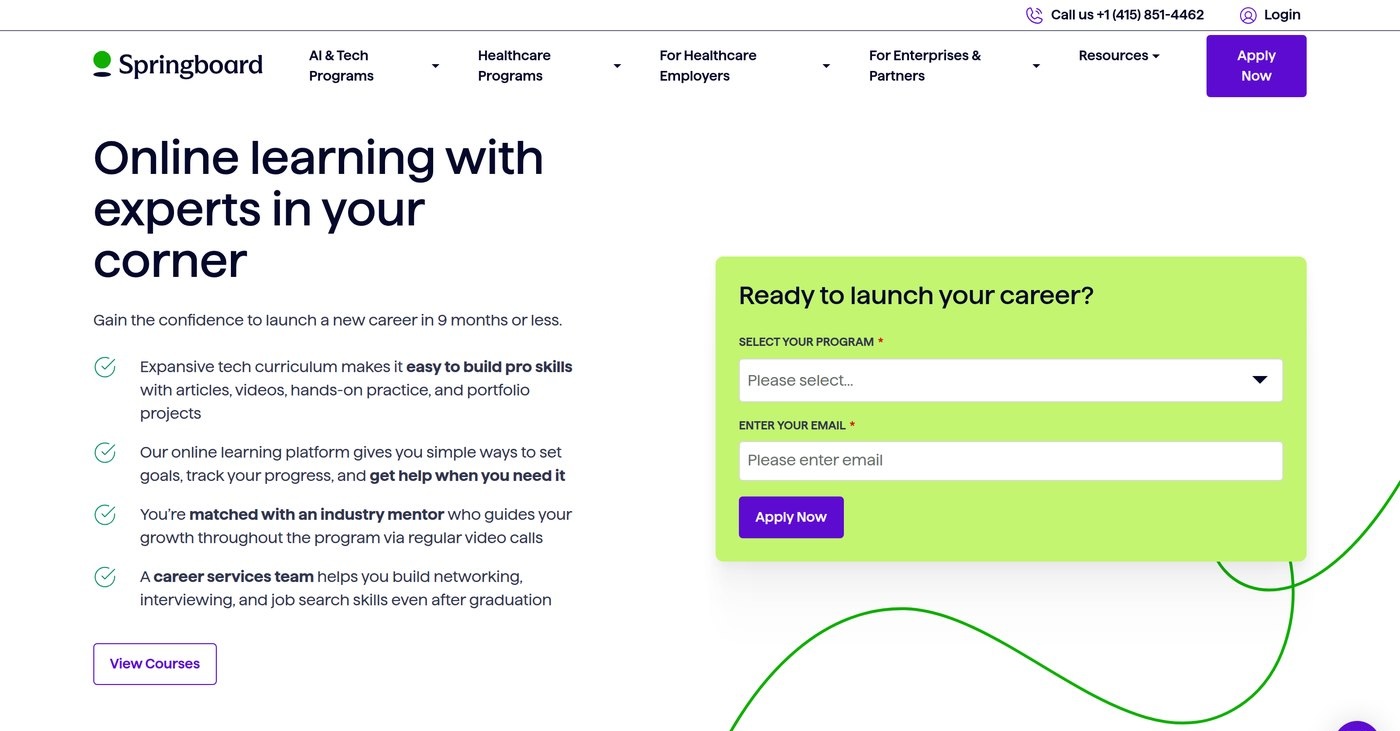
Springboard pairs every student with a working engineer for regular 1:1 video calls and builds the program around independent work. There are no live classes at all, which suits people with unpredictable schedules and frustrates people who need a room to show up to.
The Software Engineering Career Track covers JavaScript, front-end and back-end development, data structures, and algorithms, with roughly two-thirds of the time going to projects. A separate beginner track exists for people who can't yet pass the entry assessment.
Cost: $9,900 paid upfront, discounted from $13,860. Month-to-month runs $1,540, with loan financing through Climb Credit or Ascent.
Duration: 9 months at 16 to 20 hours a week. The beginner track runs 15 weeks full-time or 40 weeks part-time.
Format: fully online with no scheduled classes, structured around mentor calls and project deadlines.
Admissions: an application, a call with admissions, and a technical skills survey testing JavaScript fundamentals and problem-solving. You'll need to be 18 or older and eligible to work in the US or Canada.
Why choose it: the job guarantee covers the Software Engineering track, and it waives the bachelor's degree requirement if you have relevant industry experience. Springboard also runs co-branded versions with the University of Arizona that award a university certificate.
Worth knowing: the guarantee requires weekly job applications, networking, and weekly activity reports. Published outcomes data is dated December 2023, with nothing newer. The machine learning track has no published guarantee terms, and the Arizona versions don't advertise the guarantee at all, so confirm coverage for the exact program you pick.
Best for: self-directed learners who want an experienced engineer in their corner and can already write basic JavaScript.
5. Fullstack Academy: best for live online classes

Fullstack Academy is the most classroom-like option here. Every session is live and instructor-led with no recorded lectures to fall behind on, which fits if you learn better with people in the room and a schedule that holds you to it.
Four subjects are on offer: Software Engineering, AI & Machine Learning, Cybersecurity, and Data Analytics. Software Engineering and Cybersecurity come in full-time and part-time versions.
Cost: $4,995 to $11,995 depending on program and discount. Software Engineering and Cybersecurity list at $11,995, discounted to $7,995 and $8,995; AI & Machine Learning and Data Analytics list at $9,995, discounted to $4,995.
Duration: 12 weeks full-time, or 20 to 26 weeks part-time. Part-time students spend 9 hours a week in class plus 20 or more studying, so budget close to 30 hours either way.
Format: 100% live online. Full-time runs weekdays 10am to 2pm ET; part-time runs three evenings a week until 11pm ET.
Admissions: an application and an advisor call, with a decision in one to three business days. A high school diploma is the only hard requirement for most programs, though the AI & Machine Learning bootcamp asks for prior programming or intermediate math.
Why choose it: career services run a full year after graduation, covering 1:1 coaching, resume and LinkedIn work, interview prep, negotiation, and an employer job board.
Worth knowing: there's no job guarantee, stated plainly on the site. Outcomes reporting stops at 2021. Fullstack also powers university-branded bootcamps at Virginia Tech, the University of North Florida, and the University of San Diego at the same prices, so check you aren't comparing the same program to itself.
Best for: students who want live teaching and can protect three weeknights until 11pm, or four hours every weekday.
6. 4Geeks: best for lifetime mentorship
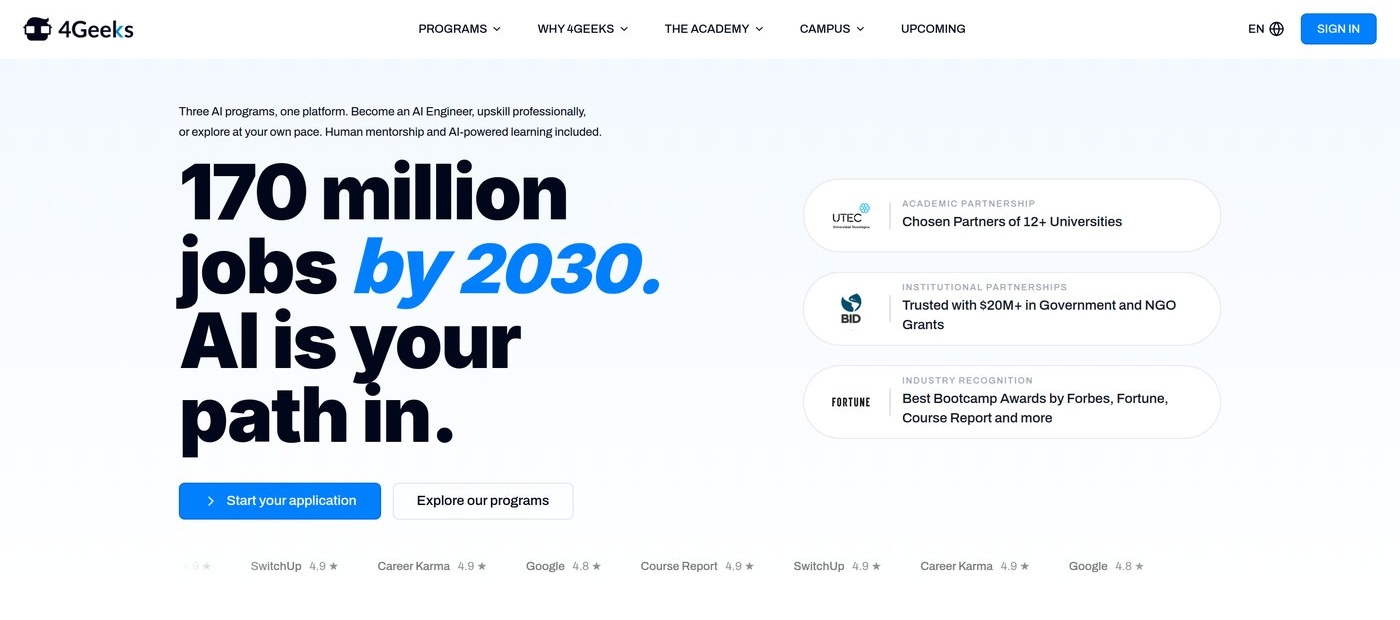
4Geeks includes unlimited 1:1 mentorship and career coaching for life as standard, not as an upsell. Its GeekPAL and GeekFORCE programs cover coding help and career support with no end date, alongside a 400-plus employer network.
The school repositioned around AI in 2026. AI Engineering is the flagship, with AI Fluency as a short non-coding option and AI Flex as a subscription. Full Stack Development, Data Science & Machine Learning, and Cybersecurity still have pages, though every cohort scheduled when we checked was AI Engineering or AI Fluency.
Cost: $14,999 for AI Engineering, $10,999 for Full Stack and for Data Science & Machine Learning, $9,999 for Cybersecurity, and $900 for AI Fluency. Paying upfront saves 10%, and six interest-free installments are available.
Duration: 22 to 24 weeks part-time for AI Engineering, or 15 to 17 weeks on the accelerated full-time track. Expect at least 24 hours a week. Full Stack runs 16 weeks, Data Science 18, Cybersecurity 16.
Format: live online with a 7:1 student-to-instructor ratio, plus in-person options. The site lists campuses across the US, Europe, and Latin America, though Miami is the only US physical location it confirms.
Admissions: an application form followed by a call. No prior coding experience required, though a logic test applies if you want the guarantee.
Why choose it: lifetime mentorship is unusual, and 4Geeks publishes dated upcoming cohorts, which several schools here don't. Scholarships include funded places through United Way Miami and a US Department of Labor program.
Worth knowing: the job guarantee is a paid add-on costing about $2,000, not part of tuition, and it's unavailable in Florida. The marketing page promises a refund if you're not hired within 9 months while the contract PDF specifies 6, so get the term in writing. 4Geeks states plainly that it can't guarantee a job, only the refund. Its newest Course Report review dates to November 2024.
Best for: students who want support that doesn't expire, and who are comfortable with a curriculum built around AI engineering.
7. Ironhack: best for an international cohort
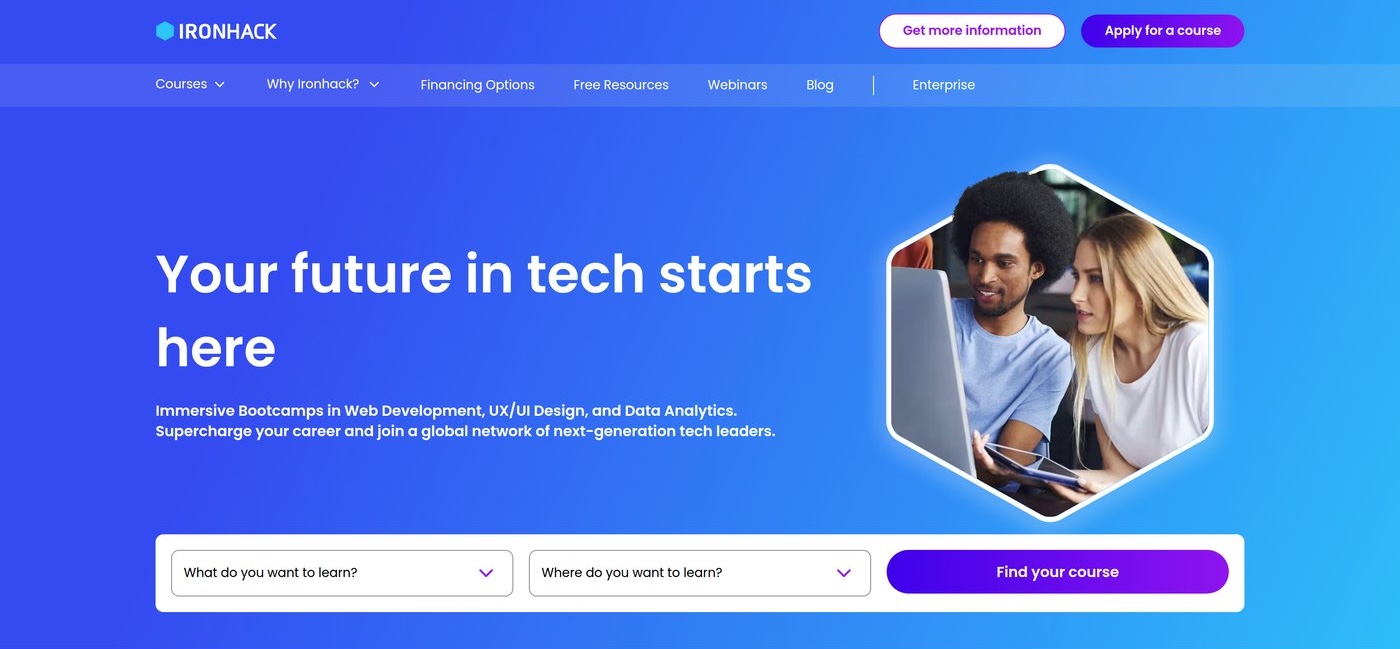
Ironhack runs the largest program catalog here, twelve subjects spanning web development, UX/UI, data, cybersecurity, DevOps, and AI, with classmates joining from across Europe and Latin America. If you want an international network rather than a US one, that's the draw.
US students have to work around the clock difference. Every remote cohort runs on Central European Time, so a full-time schedule of 9am to 6pm CET is roughly 3am to noon Eastern.
Cost: not published. Ironhack directs prospective students to financing conversations instead of listing tuition, and Course Report notes the school doesn't share pricing. Third-party sites cite figures around $12,000 to $13,000, but they disagree with each other and none is confirmed by Ironhack.
Duration: roughly 9 to 11 weeks full-time, or 24 to 26 weeks part-time. Part-time students need at least 15 hours a week on top of class time.
Format: remote for US enrollment, with in-person options at European campuses and San Juan. Ironhack no longer lists a mainland US campus, despite several review sites still showing Miami or New York.
Admissions: an application form, a call with admissions, and a technical test in English covering basic logic. No prior experience required.
Why choose it: the breadth of subjects and a global cohort, backed by more than 1,000 Course Report reviews at 4.78.
Worth knowing: there's no job guarantee or refund of any kind. Ironhack doesn't publish how long career support lasts after graduation, and the only placement figure we could find covers 2018 graduates. Combined with unpublished tuition, that's more unknowns than any other school here carries.
Best for: students in or near European time zones, or US students who can work early mornings and want an international network.
8. Flatiron School: best for earning while you train
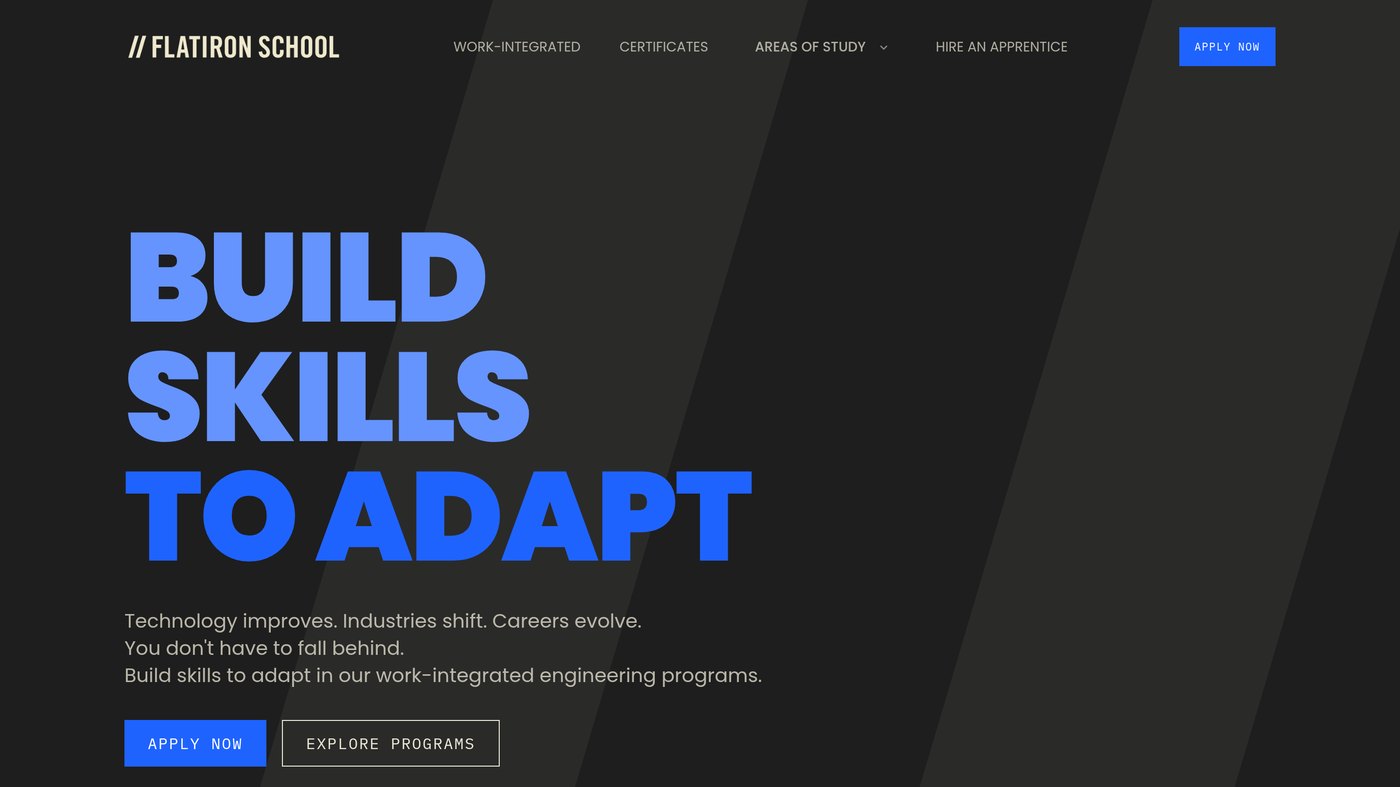
Flatiron School is no longer a bootcamp in the traditional sense, and the most interesting thing it offers now is a paid apprenticeship. Its work-integrated programs place you into paid work partway through, so you earn while you finish training.
The catalog splits in two. Certificates run part-time online in Software Engineering, AI & Data Science, and Cybersecurity. Work-integrated programs combine coursework with a paid apprenticeship in AI Engineering or Cyber Engineering.
Cost: $14,900 flat for any certificate. Work-integrated programs list at $29,900 for the 19-month version and $14,900 for the 16-month accelerated version, with apprenticeship earnings and scholarships offsetting part of that. Treat the "effectively free" framing as marketing rather than a price.
Duration: certificates run 4 months full-time or 13 to 15 months part-time. Work-integrated programs run 16 or 19 months.
Format: online, mixing modules you work through yourself with weekly live instruction and weekly 1:1 mentorship.
Admissions: most programs need only a high school diploma, English proficiency, and 18+. The accelerated work-integrated track requires mid-level engineering experience and US work authorization.
Why choose it: the apprenticeship model is unusual, and earning while training solves the problem that stops many career changers before they start.
Worth knowing: Career support is 180 days and described as optional on the certificate page. The outcomes page cites reports from 2015 and 2017, the newest Course Report review is from January 2024, and the game development programs and free intro course are gone.
Best for: career changers who can't afford to stop earning, and who are comfortable calling admissions to pin down a start date.
Bootcamp, degree, or teaching yourself?
A bootcamp is the fastest route into an entry-level job, a degree is the most portable credential, and teaching yourself is the cheapest and the slowest. Which one fits depends on what you need the credential to do.
- Teaching yourself costs the least and takes the longest. The material is free or close to it, but without structure you're guessing at what employers want, and you'll likely spend money on courses and coaching anyway. It works well for students who already have a technical job and want to add a skill. It works badly as a career change plan, because nobody is checking whether the skills you're building are the ones being hired for.
- A degree gives you the deepest theory and the most portable credential, at four years and often more than $150,000. It's the right call if you're aiming at research, want visa sponsorship, or plan to work somewhere that screens on degrees. It's a slow route into an entry-level developer job.
- A bootcamp sits between them: months rather than years, thousands rather than tens of thousands, and a curriculum built backward from job postings. The tradeoff is depth. You'll finish with a working portfolio and gaps in the theory, and you'll fill those gaps on the job.
How to choose a coding bootcamp
Start with your schedule, because it rules out more options than price does.
- Weekly hours: the range here runs from 16 to 60 hours a week. Coding Dojo's full-time track and a full-time job are incompatible; TripleTen, Springboard, and Coding Temple are built around one.
- Time zone: check when live sessions run. Ironhack's remote cohorts are on European time, Coding Temple's evenings are Central, and Fullstack's run until 11pm Eastern.
- Format: live classes give you accountability and a cohort. Independent study with a mentor gives you flexibility. Choose based on whether you've finished an online course before.
- Admissions bar: if you can't yet write JavaScript, Springboard's main track is closed to you until you pass its assessment. TripleTen, Coding Dojo, and Coding Temple take beginners directly.
- Guarantee terms: four of these eight offer some form of refund, and all four require documented weekly job-search activity. One charges extra for it. Read the conditions before treating a guarantee as a safety net.
- Verify the school is still running: look for a dated upcoming cohort on the provider's own site. Review aggregators lag by months, and in two cases here by more than a year.
Start your tech career
Choosing a program is the hard part. TripleTen offers free consultations for anyone weighing a move into tech, including an honest read on which program fits your background and what the guarantee conditions would mean for you.

.avif)