



Switching careers is a leap, and the question that matters most before you take it is simple: what comes next? If you finish a TripleTen program, what kind of work can you actually move into, and how realistic is it? It is a fair question, because a program is only worth it if real opportunities wait on the other side.
TripleTen trains people in the tech and AI skills that move them into higher-paying roles as the job market shifts, and its graduates go on to work across software, data, design, security, and quality assurance, often in industries far outside traditional tech.
This guide walks through the career opportunities open to you after you complete a program: the roles you can target, the industries that hire, what graduates earn, and how the platform helps you land the job.
Career opportunities: the tech roles you can step into after TripleTen
The role you aim for depends on the program you choose, and TripleTen builds each one around the skills employers are hiring for right now. Here is how the programs map to careers.
- The AI Software Engineering program prepares you for full-stack development work: front-end, back-end, and full-stack engineer roles where you build and ship web applications. Graduates also move into related titles such as React developer and software developer.
- The Data Analytics program leads to data analyst and business analyst roles, where you turn raw business data into decisions using SQL, Python, and tools like Power BI and Tableau.
- The AI & Machine Learning program opens the door to data scientist and machine learning roles that involve building, training, and evaluating predictive models.
- The Quality Assurance program leads to QA tester, QA analyst, and QA engineer roles.
- The Cybersecurity program prepares you for security analyst and SOC roles, and you graduate with the industry-recognized CompTIA Security+ certification alongside your TripleTen certificate.
- The UX/UI Design program leads to roles such as UX designer, UI designer, product designer, and UX researcher, where you run user research, wireframe, and build high-fidelity prototypes in tools like Figma.
- The AI Automation program prepares you for roles like AI automation specialist and workflow engineer, where you use tools such as Lovable, n8n, and the OpenAI API to build pipelines that cut manual work across a business.
- The AI Systems Engineering program is a 9-month accelerator for experienced developers and data, QA, or STEM professionals who want to move from feature-level work into system-level engineering. You build four deployed, open-source systems, learn from senior engineers who work at companies like Meta, Amazon, and Google today, and target roles such as senior software engineer, GenAI backend engineer, inference engineer, full-stack AI platform engineer, and forward deployed engineer, many of which pay well over $200,000.
Demand supports several of these paths. The U.S. Bureau of Labor Statistics projects data scientist roles to grow about 34% between 2024 and 2034, one of the fastest rates of any occupation, and information security analyst roles much faster than the roughly 4% average across all jobs. That makes AI & Machine Learning and Cybersecurity strong picks if you want demand on your side.
Most of the beginner programs lead to junior and entry-level roles to start — junior developer, associate analyst, QA tester — and they are designed as on-ramps. From there, graduates grow into mid-level and senior titles as they build experience.
What ties the paths together is how you train for them: you do not just study the tools, you use them on projects that become a portfolio. Linda Kovacs had already worked in software and wanted thorough retraining before her next move.
I really wanted to have end-to-end training from beginning to end. The front end, the back end, databases, to put everything together. — Linda Kovacs, Software Engineer at Accenture
The industries hiring TripleTen graduates
Most TripleTen graduates work in tech roles outside the tech industry entirely. Only about a quarter (25%) land in IT itself, according to the 2026 outcomes report; the rest are spread across healthcare, finance and banking, manufacturing and engineering, retail and e-commerce, education, transportation and logistics, and public and non-profit organizations. It maps to a broader shift LinkedIn has described as the rise of “new-collar” roles in non-tech sectors such as healthcare, finance, and manufacturing. Your previous experience often becomes a differentiator here: a former nurse already understands how a hospital works, and a former logistics coordinator already understands the data a shipping company cares about.
Keith Robinson is a good example of the finance path. After years of grueling contract work away from home, he completed TripleTen and moved into banking as an Assistant Vice President, Senior AML Data Science Analyst at Citibank, pairing new data skills with hard-won professional judgment. Rachelle Perez took a different route into the same broad field: she discovered data work while scrolling job listings, trained with TripleTen, and landed a data role at Spotify.
My goal is to make sure that if we have content that you will enjoy, that we help you discover it. — Rachelle Perez, Data Scientist at Spotify
Education and healthcare are common destinations too. Tiffany Hall spent 15 years as a special education teacher before becoming a Full-Stack Developer at Scholastic, the children’s publishing and edtech company, while people from clinical backgrounds move into health-tech analytics and testing. Location is flexible as well: among employed graduates, roughly 31% work fully remote, 31% hybrid, and 34% on-site, with the rest in contract or freelance arrangements.
What you can expect to earn
TripleTen publishes its outcomes every year. Our latest Student Achievement Highlights report, released in April 2026, is a level of transparency that is rare in this category: as of early 2026, only three coding schools publish independently audited outcomes through CIRR, and many others stopped reporting after 2023.
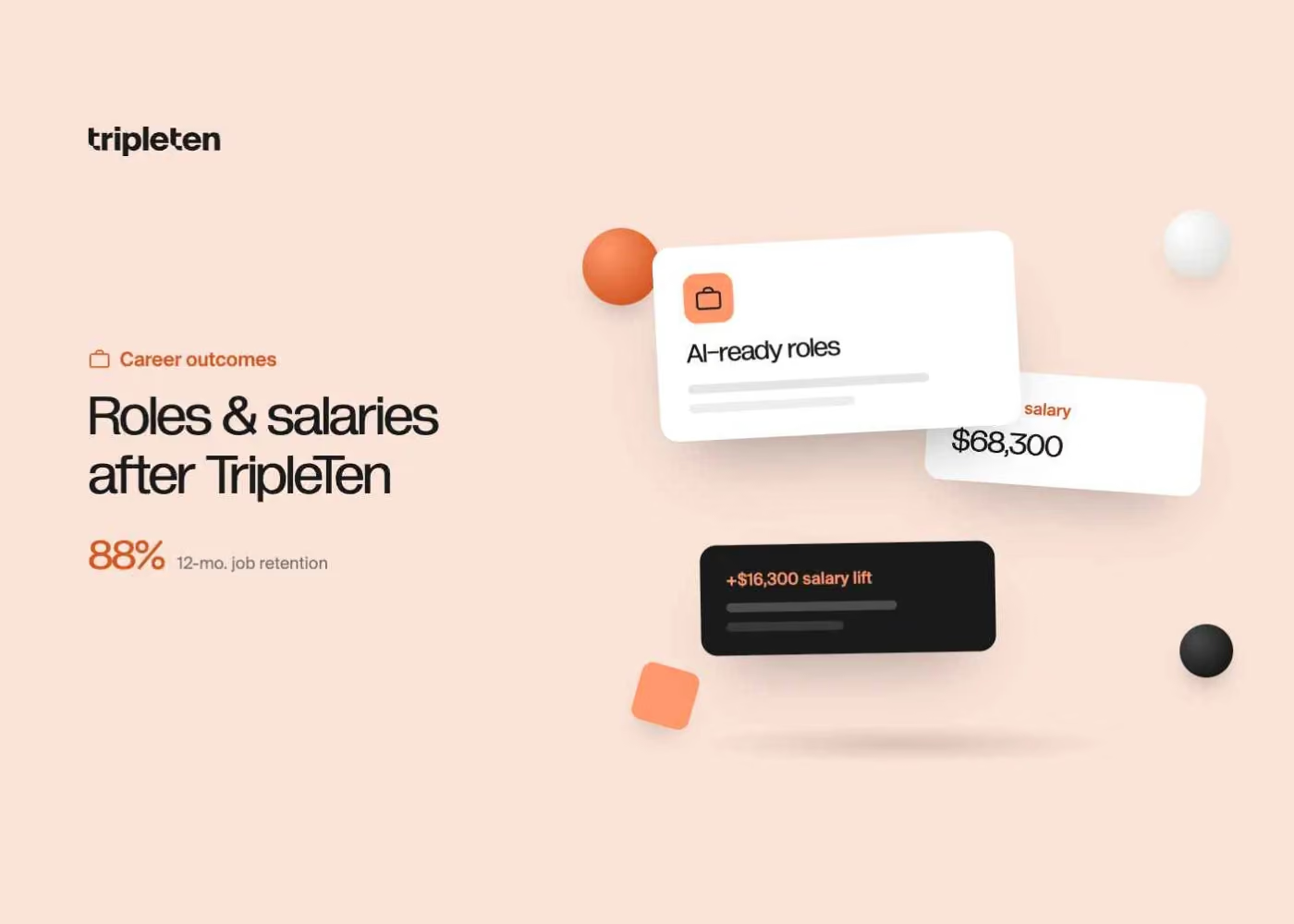
Across all programs, graduates report an average starting salary of $68,300 and an average salary increase of $16,300 over their previous roles. Medians vary by field: about $85,000 for AI & Machine Learning graduates, $65,000 for AI Software Engineering, and $62,000 for both Data Analytics and Quality Assurance. The raise over a previous job varies by field as well: around $22,500 for AI & Machine Learning graduates, $17,000 for AI Software Engineering, $15,750 for Data Analytics, and $10,000 for Quality Assurance. These figures come from surveyed graduates reporting their actual starting salaries.
Nearly two-thirds of graduates (63%) were hired within 10 months of finishing, and 88% of those who landed a role were still in it a year later.
How TripleTen helps you land a role
AI runs through how you learn at TripleTen. You practice with the AI tools and workflows employers expect, so you graduate ready to use AI on the job from day one. You learn the job by doing it — through real projects, externships with partner companies, and Code Jam hackathons — and you finish with a portfolio that shows hiring managers what you can build. Your instructors are professionals working in tech today, and the curriculum is reviewed every two months to keep pace with what employers want.
The support continues into the job search. Career coaches help you sharpen your strategy, prepare for interviews, and stay steady through the ups and downs, and an internal job board adds 300+ new openings a day, curated for the fields graduates train in. Wendy Zambrano, who became a Quality Assurance Tester at Revenue Solutions Inc. after years in a call center, leaned on that support.
I was having some emotional roller coasters, and [my coach] was there for that and showed me the support that I needed to keep moving and to keep applying and to keep looking even if my personal life was hard at the moment. — Wendy Zambrano, Quality Assurance Tester at Revenue Solutions Inc.
TripleTen also backs its programs with a money-back guarantee: complete your program, follow the job-search roadmap with your career coach, and apply within the 10-month search window. If you are not hired, you get your tuition back. Conditions apply, including weekly application and networking minimums and regular coach check-ins, and they are spelled out up front. It is one more way the platform shares the risk of your career change.
Is this realistic if you’re starting from zero?
Around 80% of TripleTen students arrive with no prior tech experience. Graduates have come from teaching, nursing, trucking, the service industry, the military, and corrections, among many other fields, and age has not been a barrier: Bill Samboy made his switch at 50, moving from work as a power-company lineman into an automation and robotics technician role.
The graduates who get hired tend to do three things: finish the program, build a portfolio that proves the skills, and work the job search consistently with a coach. A career change is demanding, especially while you are juggling a current job or family, which is why TripleTen runs on a flexible learning schedule and gives you lifelong access to course updates so your skills stay current long after you graduate.
After TripleTen, the range of roles is real: software, data, design, security, and quality work, across nearly every industry, often with a meaningful pay raise. Where you fit comes down to your background and goals, and a short quiz is a low-stakes way to narrow it down.