

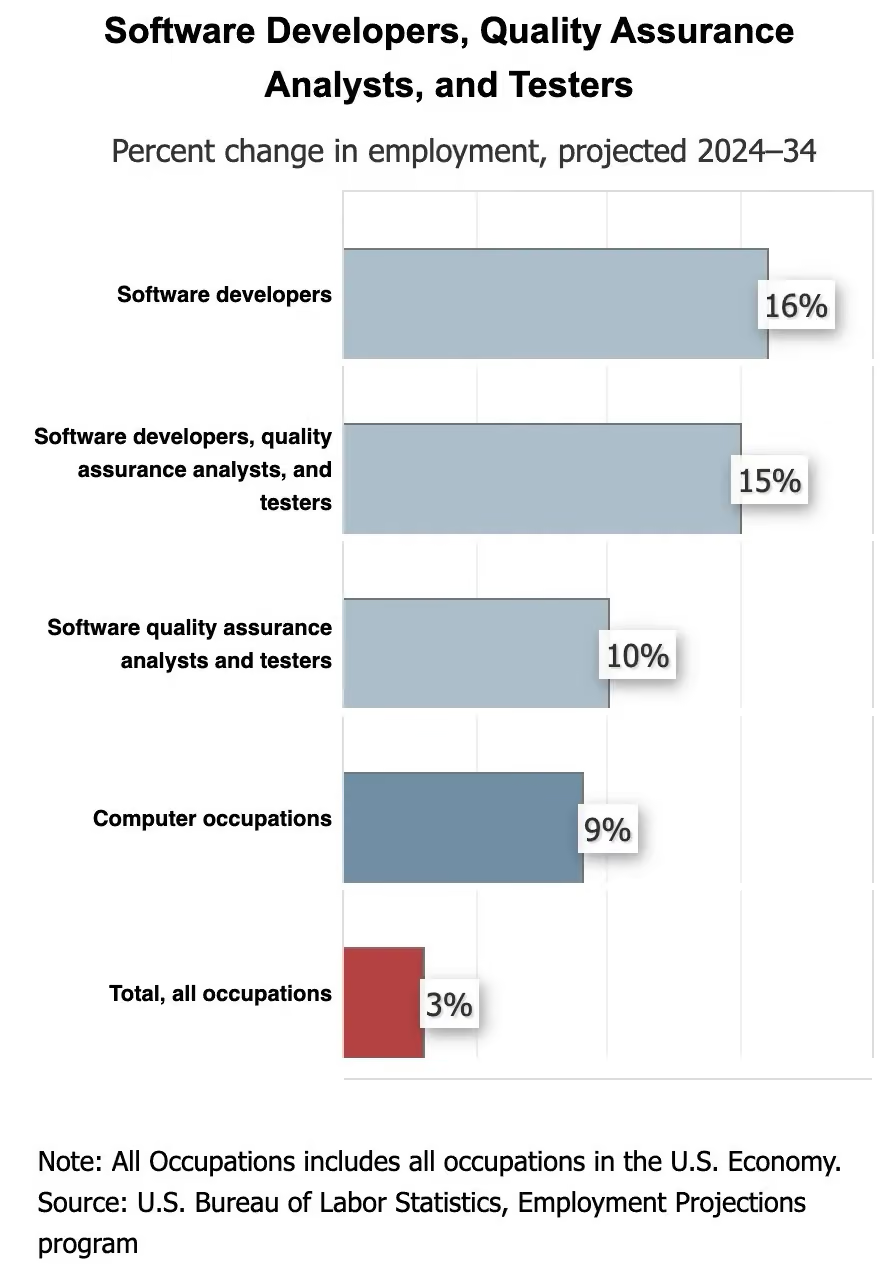
- Software engineering continues to be an in-demand, well-paid career, projected to grow 16% through 2034.
- While the best software engineering bootcamps offer a faster route to high-paying roles than traditional degrees, tuition costs vary significantly between $9,500 and $19,480.
- Choosing the right program means looking beyond tuition and diving into official outcome reports, career support and learning formats.
Software engineering is one of the most in-demand careers in the country right now—and the numbers back it up. According to the U.S. Bureau of Labor Statistics, employment of software developers is predicted to grow 16% from 2024 to 2034, roughly five times faster than the average for all occupations. About 129,200 openings are expected each year over the decade, and the median annual salary for software developers reached $133,080 in May 2024.
For career changers who can't—or don't want to—commit to a four-year degree, a software engineering bootcamp offers one of the fastest routes into a tech role.
But there’s a catch.
Your outcomes may vary significantly from program to program. There are lots of factors that may influence your results, including:
- Curriculum depth
- Instruction format
- Career services
- Job placement transparency and, of course,
- Cost.
All of that determines whether a software engineering bootcamp is actually worth your time and money. In this review, we evaluate six leading software engineering bootcamps on those same criteria so you can compare programs on equal footing.
How we evaluated the best software engineering bootcamps
To keep this comparison consistent and useful, we looked at each program through the following lens:
- Curriculum depth and technical coverage: Does the syllabus prepare students for real job requirements, including modern frameworks, databases, and deployment?
- Instruction format and scheduling: Full-time or part-time? Synchronous or self-paced? Does the structure fit typical career-changer constraints?
- Career support quality: What does post-graduation support actually include, and for how long?
- Verified student outcomes: Are job placement rates and salary figures publicly available and independently audited where possible?
- Cost and financing transparency: What are the real all-in numbers, and what payment flexibility exists?
Student ratings: We used ratings from Course Report, Career Karma, and SwitchUp—the three most widely-cited independent review platforms in the bootcamp industry.
The 5 best software engineering bootcamps in 2026
1. TripleTen: Best for non-technical students looking for an AI-ready role
- Format: Online, full-time, and part-time
- Duration: 6 months part-time track; 4 months full-time track
- Tuition: $10,500 upfront; installment plans available (3 months up to 58 months with a deposit)
- Rating: 4.83/5 on Course Report. 4.7/5 on Career Karma. 4.87/5 on SwitchUp
TripleTen highlights:
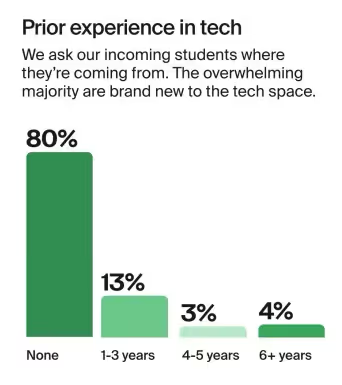
- 80% of bootcamp graduates since 2020 have gone on to launch a career in tech with no previous technical experience. 88% stay employed for at least a year in the tech fields they trained for.
- Alumni have been hired at Microsoft, Amazon, Tesla, and Accenture — just a few of the names in TripleTen’s network of hiring employers.
- Comprehensive career development services for graduates, including career coaching, resume and portfolio building, interview preparation, and job hunting support.
- Externships are permanently available to all graduates, allowing them to gain hands-on experience with actual businesses.
- TripleTen offers a conditional money-back guarantee (100% tuition refund if you don’t get hired within 10 months of graduating).
Some bootcamps assume you already know what a for-loop is. TripleTen’s AI software engineering bootcamp is built for people who don't.
There's no admissions test or an assumed baseline, making this software engineering bootcamp ideal for career switchers moving away from healthcare, education, finance, or hospitality. Since 2020, 2,600+ graduates have completed TripleTen’s tech bootcamps and gone on to land roles in tech, with 80% having no previous technical experience.
The full-stack curriculum is designed to prepare students for AI-ready tech roles. It covers HTML, CSS, JavaScript, React, Node.js, MongoDB, and Git/GitHub through six cumulative real-world projects—each reviewed line by line by a working engineer, not an automated grader. Tutors are available by appointment and in open office hours throughout.
“Since 2020, 2,600 graduates have completed TripleTen’s tech bootcamps and gone on to land roles in tech, with 80% having no previous technical experience...”
Tuition and financing information
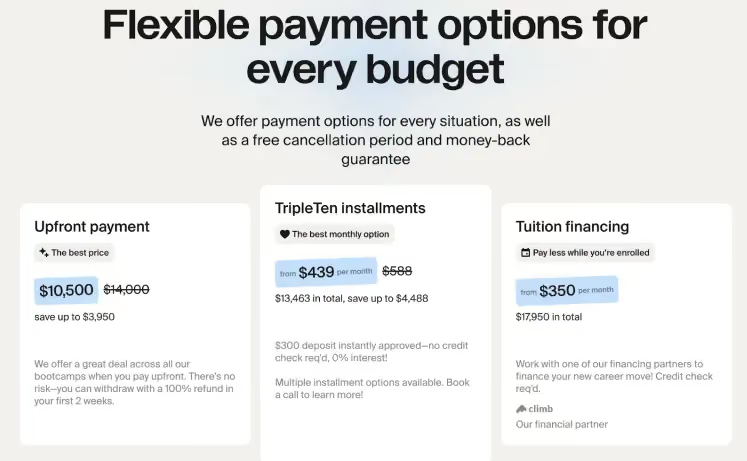
TripleTen’s standard tuition is $14,000, but paying upfront saves you up to $3,950, bringing the cost down to $10,500.
If you need flexibility, installment plans are available starting at $439 per month, which require a $300 deposit that’s instantly approved without a credit check. Financing can run from 3 to 58 months.
The fine print: While the installment plans offer long-term flexibility, opting to stretch your payments out over 58 months means missing out on the upfront discount, increasing your total out-of-pocket cost.
TripleTen offers a conditional 100% money-back job guarantee. To qualify for a refund, you must be a U.S. resident, complete all required career preparation modules, and maintain a strictly documented job search for 10 months after graduation.
TripleTen job search and career support
TripleTen treats job hunting as part of the curriculum, ensuring that career changers are genuinely set up for success.
Learning support and career coaching range from interview prep and AI-powered resume builders to unlimited coaching. In fact, students received over 1,600 hours of career coaching in 2025 alone.
Beyond prep, you get exclusive access to a job board updated with 300+ new opportunities daily and direct connections to an actively expanding network of employers.
To help bypass the entry-level "experience required" trap, TripleTen also offers externships where you build real-life projects for partner companies, reporting that over 90% of students who complete these externships get hired.
What students are saying
Alumni feedback across Course Report, Career Karma, and SwitchUp consistently highlights TripleTen’s balance of high-touch support and independent flexibility.
2. App Academy: Best for those who want to pay only after being hired
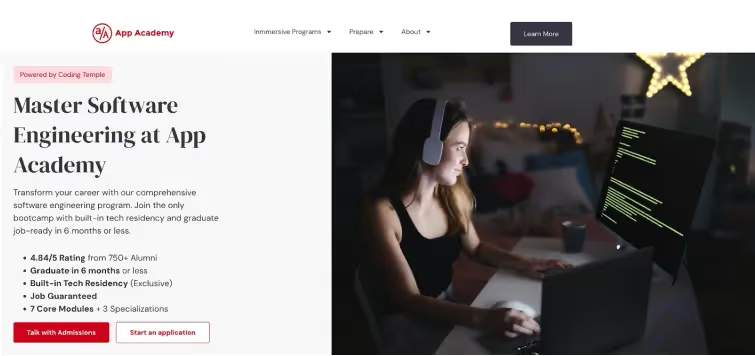
- Format: Online immersive, full-time
- Duration: 24 weeks full-time (6 months or less)
- Tuition: $9,500 upfront ; deferred tuition and installments available
Rating: 4.7/5 on SwitchUp, 4.7/5 on Career Karma
App Academy highlights:
- One of the more selective admissions processes—a high-caliber peer cohort
- Dedicated career coaches are active throughout the job search
- Graduates get access to Launchpad, App Academy’s exclusive network of hiring 5,000 hiring businesses, and Tech Residency, live security projects offering real dev team experience
- In 2019, the placement rate* of graduates was 93% in San Francisco and 95% in New York.
App Academy’s software engineering bootcamp will require you to complete a technical assessment. This will ensure that you’re in an ideal position to complete the program. As of writing, the program offers a full-time track that gets students job-ready in six months or less (24 weeks).
App Academy’s software engineering curriculum covers Python, JavaScript, React, Redux, SQL, and HTML/CSS through pair programming and team projects. Admissions includes a technical assessment.
“The company offers Launchpad, a network of hiring partners that offer expedited career opportunities to graduates.”
Tuition and financing information
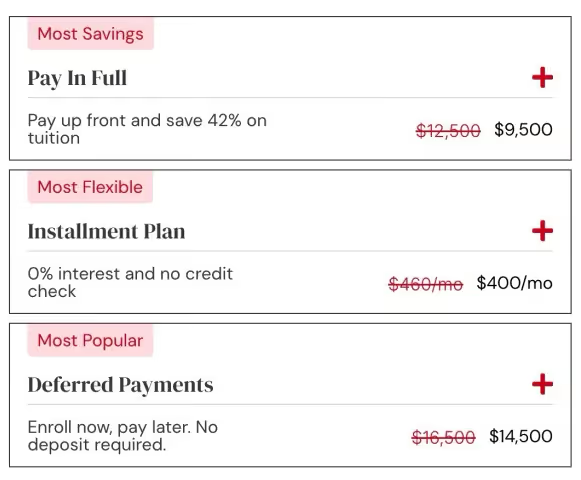
App Academy lists their standard upfront tuition at $12,500, but paying in full scores you a discount that brings things down to $9,500.
If you need flexibility, they offer an installment plan of $400 per month for 36 months, which requires a $200 deposit but comes with 0% interest and no credit check. App Academy also heavily advertises its deferred payments option (priced at $14,500 before interest), which requires zero deposit and allows you to defer payments until three to nine months after graduation through partners like Climb or Edly.
The fine print: App Academy offers a money-back guarantee with rigorous academic and job-search requirements that can void your financial protections.
For starters, you’ll need to pass two critical assessments in the first part of the program to proceed, and you are subject to a strict "strike policy" for attendance and behavior. You’re also required to conduct a "Good Faith Job Search" for an eligible period of 36 months, which means spending 40 hours a week on job hunting and sending at least 25 applications weekly.
Failure to document these activities and meet with career coaches regularly will void your tuition forgiveness.
App Academy job search and career support
App Academy provides daily guidance to students, pairing you with dedicated career coaches who are active throughout your job search. Their claim to fame is the Tech Residency program, which gives students access to real-world projects and resources to prepare for industry certification.
Graduates also unlock Launchpad, an exclusive network of hiring partners that offer expedited career opportunities.
What students are saying
Here’s what people are saying about App Academy on SwitchUp.
3. Hack Reactor: Best for VA students graduating in under four months
- Format: Online immersive (full-time) or part-time
- Duration: 16 weeks (full-time), 30 weeks (part-time)
- Tuition: $19,480; ISA and loan financing available. Merit Scholarships are awarded to candidates who pass the criteria†ha cognitive aptitude test (CCAT)
- Rating: 4.62/5 on Course Report. 4.75/5 on SwitchUp. 4.8/5 on Career Karma.
Hack Reactor highlights
- Coursework covers AI and how to use AI tools
- The beginner track requires no prior coding experience
- VET TEC eligible—qualifying veterans can attend at no cost
- ISA deferred tuition is available as an alternative to upfront payment
- 14,000+ alumni across 1,100+ companies.
Hack Reactor offers a full-time, 16-week online coding bootcamp that teaches learners how to use AI and AI tools in preparation for the modern tech workforce. There’s also a part-time bootcamp running for up to 30 weeks. Both tracks are open to students with no prior coding experience, with learners studying at their own pace for 40–60 hours/week.
HackReactor’s curriculum is JavaScript-first, covering algorithms, data structures, React, Node.js, databases, deployment, and GitHub Copilot. There is, however, a 15-minute CCAT for gating admissions.
“Hack Reactor is VET TEC eligible. Qualifying veterans can attend at no cost.”
Tuition and financing information
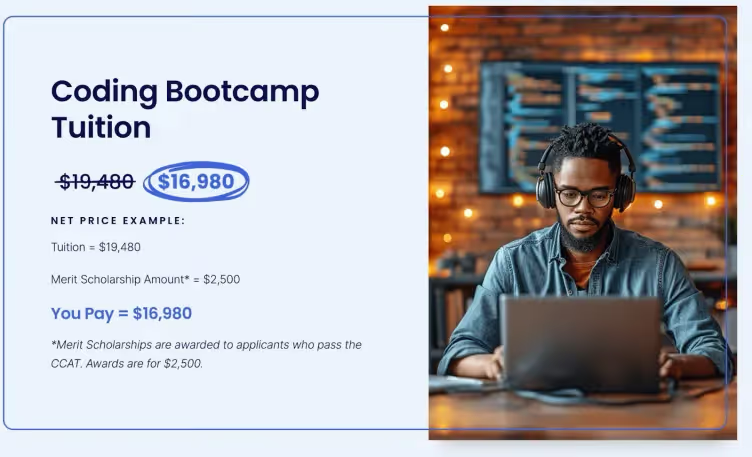
With a tuition of $19,480, Hack Reactor's full-time coding bootcamp is the most expensive on this list. If you need flexibility, you can split the cost (50% upfront, 50% at the midpoint) or apply for third-party loans. They offer a $2,500 Merit Scholarship if you pass a cognitive aptitude test (CCAT).
A standout feature of Hack Reactor is that they’re an approved provider for the VET TEC program. This allows qualifying veterans to complete the course tuition-free through the VA program without counting against their GI Bill® entitlement.
The fine print: Hack Reactor does not offer a money-back job guarantee. They’ve also replaced their old ISAs with a "Payment Protection Loan" (PPL). Their PPL model acts as a "pay-later" safety net but requires a hard credit check and a $100 non-refundable deposit. To maintain PPL eligibility during the job search, graduates are expected to follow a rigorous "Pathway Program™" that includes high weekly application targets and regular tracking through the Huntr platform.
Academically, the bootcamp is "sink or swim”— students must pass a Summary Assessment to graduate, and failing can lead to immediate dismissal with only a prorated refund.
Hack Reactor job search and career support
Hack Reactor grants graduates access to an active network of over 14,000 alumni across 1,100+ companies. While career services are available, the program does not publicly publish its placement data. Instead, third-party estimates suggest an approximate 85% placement rate within 180 days of graduation.
What students are saying
Feedback on Course Report and Career Karma describes Hack Reactor as a high-intensity program with a heavy emphasis on community and swift technical growth.
4. Springboard: Best for students who learn better one-on-one
- Format: Full-time and part-time (self-paced with structure)
- Duration: 36–40 weeks full-time and 13–15 weeks full-time
- Tuition: $13,860 standard; upfront payment saves approximately 29% (~$9,900 upfront with discount).
- Rating: 4.6/5 on Course Report. 4.67/5 on SwitchUp. 4.6/5 on Career Karma.
Springboard highlights
- Weekly 1:1 sessions with an assigned working engineer, not a teaching assistant or peer
- Job guarantee: 85.6.% placement rate (based on 2023 data)
- Paid coaching sessions to guide bootcamp graduates into a new tech role
- Multiple payment paths, including 0%-deposit deferred tuition
- No bachelor's degree required for the software engineering track
- Scholarships for veterans, women, and underrepresented groups
Springboard offers two software engineering bootcamps at the same price:
- Coding Bootcamp: Foundations to Core: Full-time course with no experience required; starts with HTML, CSS, and JavaScript basics before moving into the core curriculum.
- Software Engineering Career Track: Part-time course that requires knowledge of JavaScript fundamentals and skips straight to full-stack development.
Both tracks share the same core curriculum (developed with Colt Steele of Udemy): JavaScript, React, Node.js, MongoDB, and Python through five portfolio projects, including a MERN stack capstone, plus a new AI for Engineers unit.
Both options also have an identical support structure: a dedicated 1:1 mentor (a working software engineer), a personal career coach, and a student advisor. If you've always learned better in one-on-one environments than in classrooms, that's a structural advantage worth having.
“Students get weekly 1:1 sessions with an assigned working engineer.”
Tuition and financing information
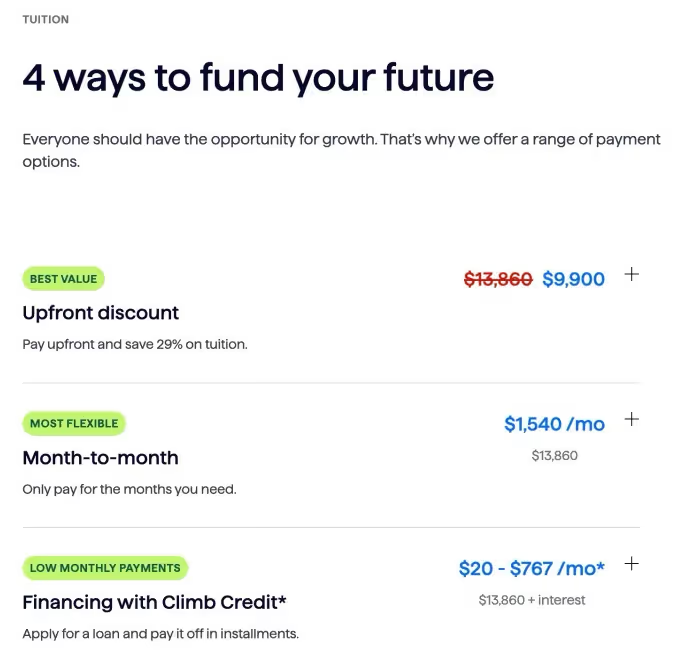
Springboard's standard tuition is approximately $13,860, but paying the full fee upfront cuts it down to $9,900.
If you need flexibility, multiple payment paths are available, including a 0% deposit deferred-tuition option. Scholarships are also available specifically for veterans, women, and underrepresented groups.
The fine print: Springboard offers a 6-month money-back job guarantee, but the safety net comes with strict requirements.
To qualify, you must complete all coursework on time and hit rigorous weekly quotas for job applications, networking, and career coaching calls after graduation. You’ll also need to document all your job search activities.
The biggest catch? Accepting any job that doesn’t meet the criteria for a role in software engineering immediately voids your refund eligibility.
Springboard job search and career support
Springboard's support structure revolves around personalized guidance. Students get weekly 1:1 sessions with an assigned working engineer — not a teaching assistant or peer.
You’re also paired with a personal career coach and a student advisor. Regarding outcomes, Springboard publishes a placement rate of 85.6% within 12 months, based on 2023 data.
What students are saying
Here's a quick look at what people are saying about Springboard on Course Report.
5. General Assembly: Best for those who want an in-person classroom experience:
- Format: Online or in-person at 20+ campuses; full-time (12 weeks) and part-time (32 weeks) options
- Duration: 12 weeks full-time / 32 weeks part-time
- Tuition: Up to $16,450 full-time; financing through Climb Credit at 0% interest available; veterans can use their GI Bill® benefit in select U.S. markets.
- Rating: 4.27/5 on SwitchUp. 4.3/5 on Course Report. 4.5/5 on Career Karma
General Assembly highlights
- The only bootcamp on this list with true in-person classroom options in 20+ cities
- Employer hiring partners and direct employer connections
- Career coaching embedded from day one, not just post-graduation
- Financing: 0% interest Climb Credit financing with a 12-month grace period
- GI Bill® accepted for qualifying veterans in select U.S. markets.
Founded in 2011, General Assembly is the only software engineering bootcamp on this list with genuine in-person classrooms across 20+ cities—including New York, Los Angeles, Austin, Chicago, Seattle, and London. If you’re the type who retains information better in a traditional classroom setting, that distinction might be a game-changer.
“The only bootcamp on this list with true in-person classroom options in 20+ cities”
Tuition and financing information
General Assembly's full-time bootcamp will set you back $16,450 or more. While paying upfront can sometimes secure a slight discount, the financial commitment is hefty.
If you need flexibility, GA offers a 36-month 0% interest loan via Climb Credit with a 12-month grace period. In certain markets like the UK, they offer an EdAid deferred plan requiring a £1,000 upfront deposit, where you pay the rest once you earn over £25,000. The GI Bill® is also accepted for qualifying veterans in select U.S. markets.
The fine print: General Assembly does not offer any form of a money-back job guarantee. And because placement data varies by city and cohort (and their most recent outcomes report does not disclose average salary figures), your financial risk rests entirely on your own shoulders.
General Assembly job search and career support
General Assembly embeds career coaching the moment you sign up for a bootcamp. You also gain access to a massive established network of employer hiring partners.
This "employer-led" approach is designed to provide direct connections and networking opportunities that help career changers bypass the traditional "black hole" of online applications.
What students are saying
Here's a quick look at what people are saying about GA on Course Report.
Quick comparison: Software engineering bootcamps at a glance
Do your research before deciding on the best software engineering bootcamp
Choosing a software engineering bootcamp is a big commitment, both in terms of money, time, and emotions. Don’t just settle for the information in each bootcamp’s syllabi. Seek out their latest outcomes reports, reach out to graduates, and try to join free workshops and sessions before signing anything. Above all: read the fine print.
Ultimately, the best program is the one that suits your specific needs and goals, and where you need to realistically be within the next 12 months. For more information, dive into our comparison of the best coding bootcamps of 2026. You can also learn how to maximize your bootcamp experience in our guide on how to get the most out of a coding bootcamp.
Frequently asked questions about software engineering bootcamps
Do I need prior coding experience to switch careers into software engineering via a bootcamp?
No. The top coding bootcamps on this list accept students with no coding experience. App Academy and Springboard have non-technical assessments. Springboard also has tracks for more advanced students with a foundation of coding skills.
How long does it take to find a job after a career change through a bootcamp?
It varies more than most bootcamps advertise. In 2024, 82% of TripleTen’s software engineering graduates found tech employment within six months of graduation. Springboard reports a 85.6% placement rate for their bootcamp. Other bootcamps don’t share information about their job placements at all.
Your timelines will also depend on your local job market, how actively you network, portfolio quality, and how consistently you use career support resources.
Is a software engineering bootcamp worth it for a career changer versus a traditional CS degree?
For career changers targeting entry-level software engineering roles, the best programming bootcamps offer a dramatically faster and more affordable path—typically 3–10 months versus 4 years, and $10,000–$21,000 versus $80,000–$200,000+ for a four-year CS degree.
Degrees offer deeper theoretical foundations, which matter more for research, systems engineering, and academic roles. For web and full-stack development at most employers, a strong portfolio and demonstrable skills may carry more weight than the type of credential.
According to SwitchUp research, the share of bootcamp alumni hired at major tech companies is nearly identical (sometimes more) to that of CS degree holders.
What salary can I realistically expect as a bootcamp graduate career changer?
Entry-level expectations should be grounded in real data, not ceiling figures. According to TripleTen's Student Achievement Highlights 2026 report, the median salary for software engineer graduates is $65,000.
The BLS median for all software developers is $133,080 (May 2024), which reflects mid-career professionals. A realistic target for most career changers entering at the entry level is $65,000–$100,000, depending on location and specialization.
What should I expect from career support as a career changer?
The best programming bootcamps treat career support as part of the curriculum, not an afterthought.
TripleTen and Springboard (paid coaching) are consistently noted in reviews for the quality of their career coaching. General Assembly embeds coaching from day one. App Academy and Hack Reactor both offer active career services.
When looking for a software development bootcamp, be sure to ask specific questions about response times, coach-to-student ratios, and how long support continues post-graduation.

.avif)



.webp)