

%20(2).avif)




Key takeaways
- TripleTen's AI & Machine Learning accelerator is the best overall option for working engineers moving into ML: 20 weeks, part-time, five stacked projects that ship as one deployed product, and a skills audit instead of a degree requirement.
- Total cost across the seven programs here runs from $3,690 to roughly $26,000, and two bootcamps that topped 2025 roundups, Caltech's and BrainStation's, have since closed or been replaced by short certificates.
- The field now splits four ways: career accelerators for engineers, live-cohort bootcamps for newcomers, graduate certificates that carry academic credit, and online master's degrees that cost less than most bootcamps did five years ago.
Machine learning is one of the few tech specialties still adding headcount while the broader market cools. The US Bureau of Labor Statistics projects 35% growth for data scientists between 2025 and 2035, 95,400 new jobs, at a median wage of $120,230. The World Economic Forum's Future of Jobs Report 2025 puts AI and machine learning specialists among the three fastest-growing roles worldwide through 2030, alongside big data specialists and fintech engineers.
Pay tracks the demand: Glassdoor puts median total pay for US machine learning engineers at $165,000 as of September 2026, within a typical range of $133,000 to $208,000.
So the career makes sense. The question is which program gets you there, and the answer changed a lot in the last year. Several well-known bootcamps shut down, and university degrees dropped into bootcamp price territory. Here's what's worth your money in 2026.
The 7 best machine learning bootcamp provides in 2026
These seven programs cover the full range of entry points, from a weekend certificate to an accredited master's degree.
| Program | Type | Format | Duration | Total price | Admission bar |
| TripleTen AI & Machine Learning | Career accelerator | Online, part-time | 20 weeks | $12,600–$20,000 | 2+ years engineering experience, skills audit |
| Simplilearn and Michigan Engineering AI/ML Certificate | Professional certificate | Live online, weekends | 24 weeks | $3,690 | Basic programming and math |
| Fullstack Academy AI & Machine Learning | Bootcamp | Live online, evenings | 23 weeks | $4,995–$5,995 | Programming or math background |
| UT Austin Online MSAI | Master's degree | Online, asynchronous | 18–36 months | $10,000 plus fees | Bachelor's, GRE not required |
| Georgia Tech OMSCS, ML specialization | Master's degree | Online, asynchronous | Up to 6 years | ~$8,900–$10,100 | Bachelor's, 3.0 GPA preferred |
| Stanford AI Graduate Certificate | Graduate certificate | Online, on-demand | 1–3 years | $21,086–$25,952 | Bachelor's, 3.0 GPA, calculus and programming |
| UW Certificate in ML & Deep Learning | Graduate certificate | In person, Seattle, evenings | 3–9 months | ~$13,900 | Bachelor’s, programming and college math |
1. TripleTen AI & Machine Learning: best overall for working engineers
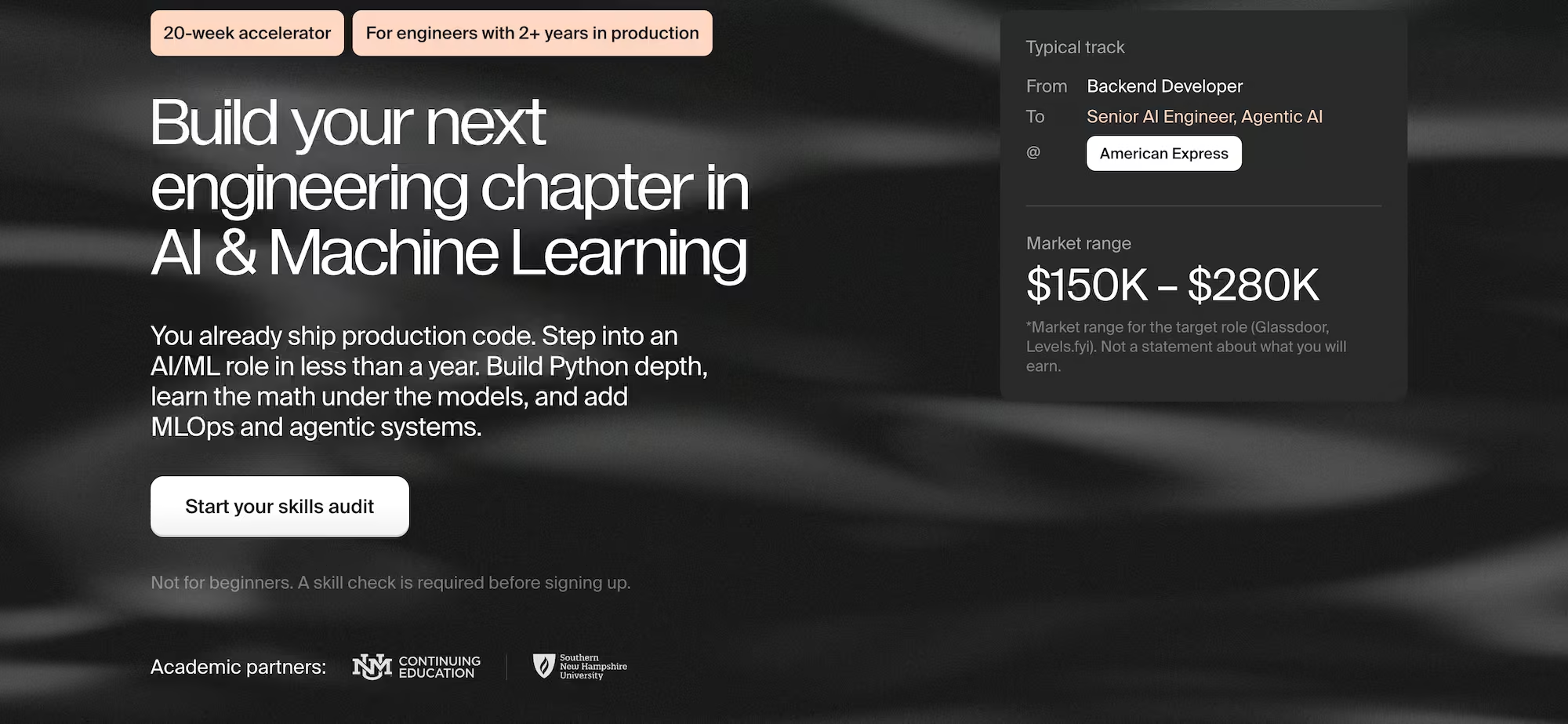
TripleTen's AI & Machine Learning program is a 20-week accelerator for engineers who already ship production code and want to move into ML, GenAI, or applied AI roles. It's the only option here designed specifically for that lateral move rather than for a standing start.
The curriculum runs on five projects that stack into one deployed product: a product requirements doc taken through to a working model, that model pushed into production on AWS with observability and service-level objectives, a clinical LLM fine-tuned with LoRA on SageMaker, a support agent built on RAG and tool use over LangGraph and MCP, then a capstone with streaming, multi-tenancy, and cost guardrails. Roughly a third of the time is theory, and the rest is building.
- Cost: $12,600 upfront, or up to four payments. Tuition financing totals $17,950 from $350 a month. TripleTen's own installment plan totals $20,000 with a $1,000 deposit and 0% interest over 6, 12, or 24 months. Employer reimbursement documentation is available on request.
- Duration: 20 weeks at 10–15 hours a week, stretching to around 7 months at a lighter pace.
- Format: online and part-time, with no mandatory class times and about two hours of live sessions a week.
- Ratings: 4.8/5 on Course Report, 4.7/5 on Career Karma.
Why choose it: a career coach joins you around week six rather than after you finish, which is unusual for a program this short. You'll get AI mock interview practice, a live mock with your coach once you reach an employer's interview stage, and a job board carrying 300+ new postings a day from 250+ partner companies. Every project you defend becomes a portfolio case study. Instructors and reviewers are engineers working in tech today.
Worth knowing: this program carries no money-back guarantee, unlike TripleTen's entry-level programs. You get a two-week withdrawal window with a full refund instead. It also isn't open to beginners: you'll need at least two years of production experience in software, data, DevOps, QE, or quantitative work, and you'll have to pass a skills audit before enrolling. Prior ML experience isn't required.
Best for: software, data, and DevOps engineers who want to add ML depth without pausing their career or committing to a multi-year degree.
2. Simplilearn and Michigan Engineering: best for a light weekly schedule
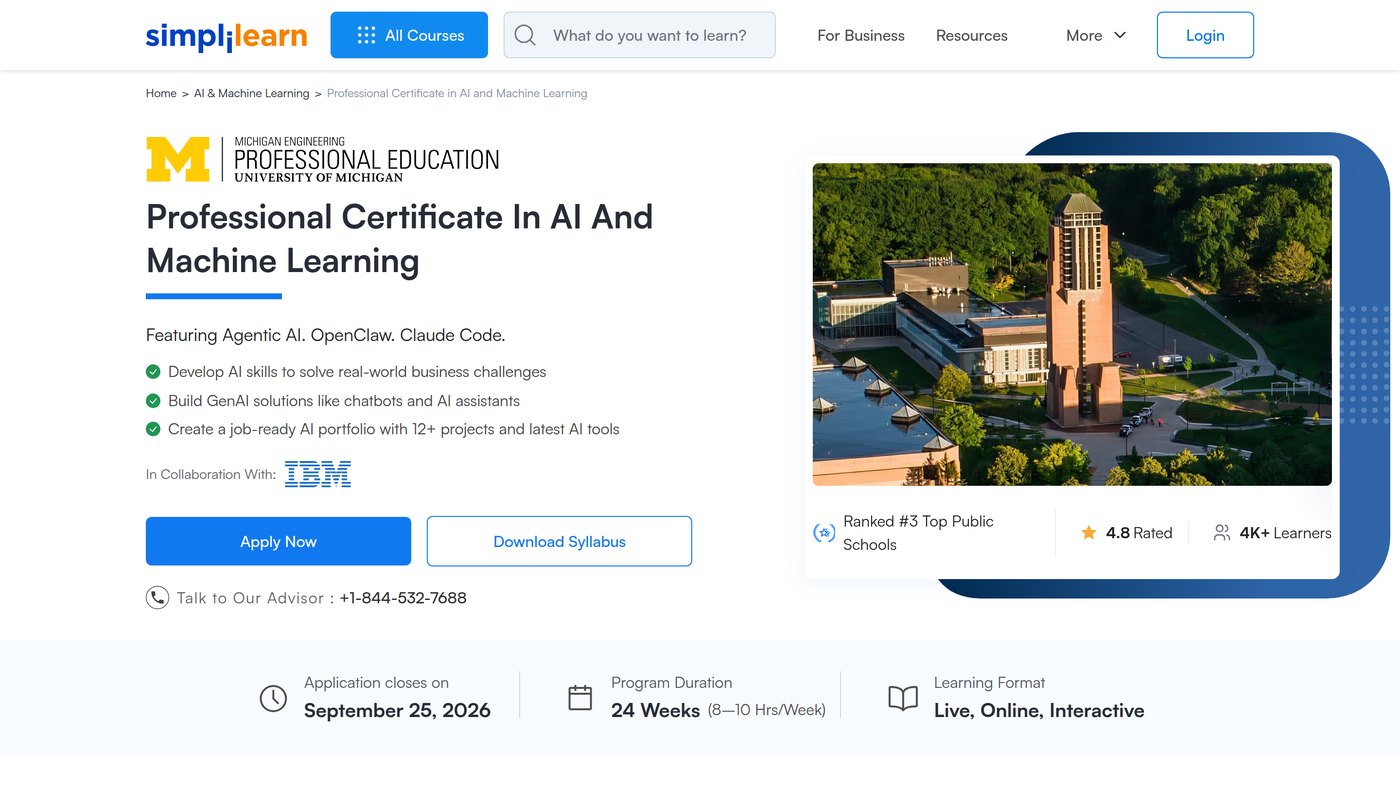
Simplilearn's professional certificate with Michigan Engineering asks for 8–10 hours a week on weekends, which makes it the easiest program here to fit around a full-time job and family. Simplilearn runs it with Michigan Engineering Professional Education, with content contributed by IBM.
Classes run live on Saturdays and Sundays, 10 a.m. to 2 p.m. ET, over 24 weeks. The syllabus opens with a Python refresher, then moves through applied data science, machine learning, deep learning, NLP, generative AI, prompt engineering, transformers, and agentic AI, with 12+ portfolio projects along the way.
- Cost: $3,690, discounted from $4,099. That makes it the lowest-priced option on this list by a wide margin.
- Duration: 24 weeks, 8–10 hours a week.
- Format: live online, weekends only.
- Prerequisites: basic programming and math familiarity. Two or more years of work experience is preferred rather than required, and the Python refresher module gives newcomers somewhere to start.
- Ratings: 4.64/5 on Course Report across 2,274 reviews, 4.4/5 on Career Karma across 1,959 reviews.
Worth knowing: career support covers workshops, an AI resume builder, a job tracker, and mock interviews, with no job guarantee attached.
Best for: career changers who can only study on weekends and want a recognized university co-brand without taking on degree-level tuition.
3. Fullstack Academy: best for live evening classes
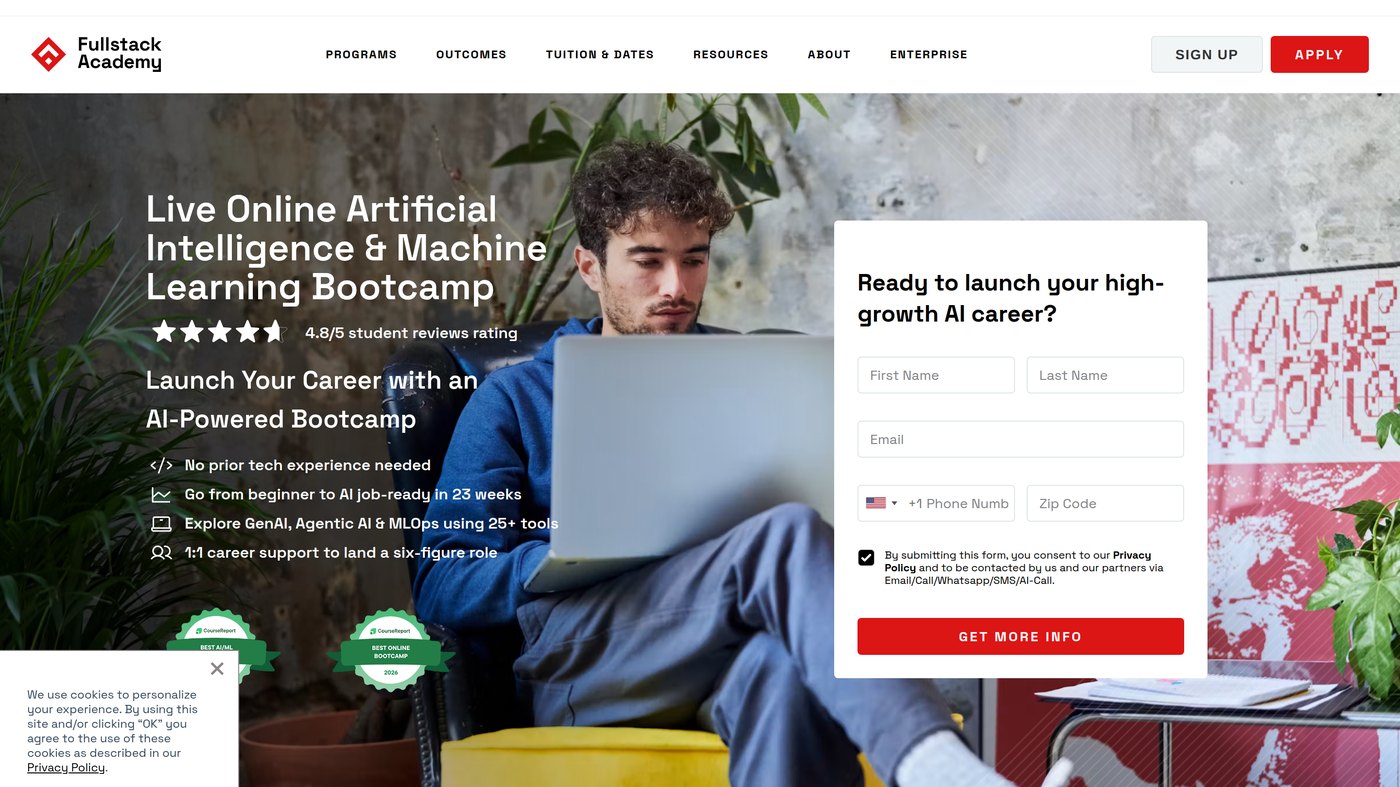
Fullstack Academy's AI & Machine Learning bootcamp is fully live and synchronous, three evenings a week, for students who learn better with an instructor in the room than with recorded video. It's also sold under several university brands, including Virginia Tech Continuing and Professional Education.
Nine units take you from programming fundamentals through applied data science with Python, machine learning, deep learning, MLOps, NLP, generative AI, and agentic AI frameworks, ending in a capstone project.
- Cost: $4,995 upfront, down from a $9,995 list price, or $5,995 in installments or through loan financing. A $500 deposit is refundable until the end of week one.
- Duration: 23 weeks. Expect 9 hours of live class plus 20 or more hours of study a week, so close to 30 hours total.
- Format: 100% live online, Monday, Wednesday, and Thursday, 8 to 11 p.m. ET.
- Ratings: 4.78/5 on Course Report, 4.6/5 on Career Karma.
Worth knowing: the marketing says no prior tech experience is needed, while the admissions section on the same page asks for programming knowledge or intermediate math including linear algebra, probability, and statistics. There's no prep course bridging the gap, so ask admissions which standard applies to you. Career support runs up to a year after graduation and covers 1:1 coaching, resume and LinkedIn work, interview prep, and salary negotiation. No job guarantee.
Best for: career changers with some coding or math grounding who want live instruction and can protect three weeknights until 11 p.m..
4. UT Austin Online MSAI: best master's degree under $11,000
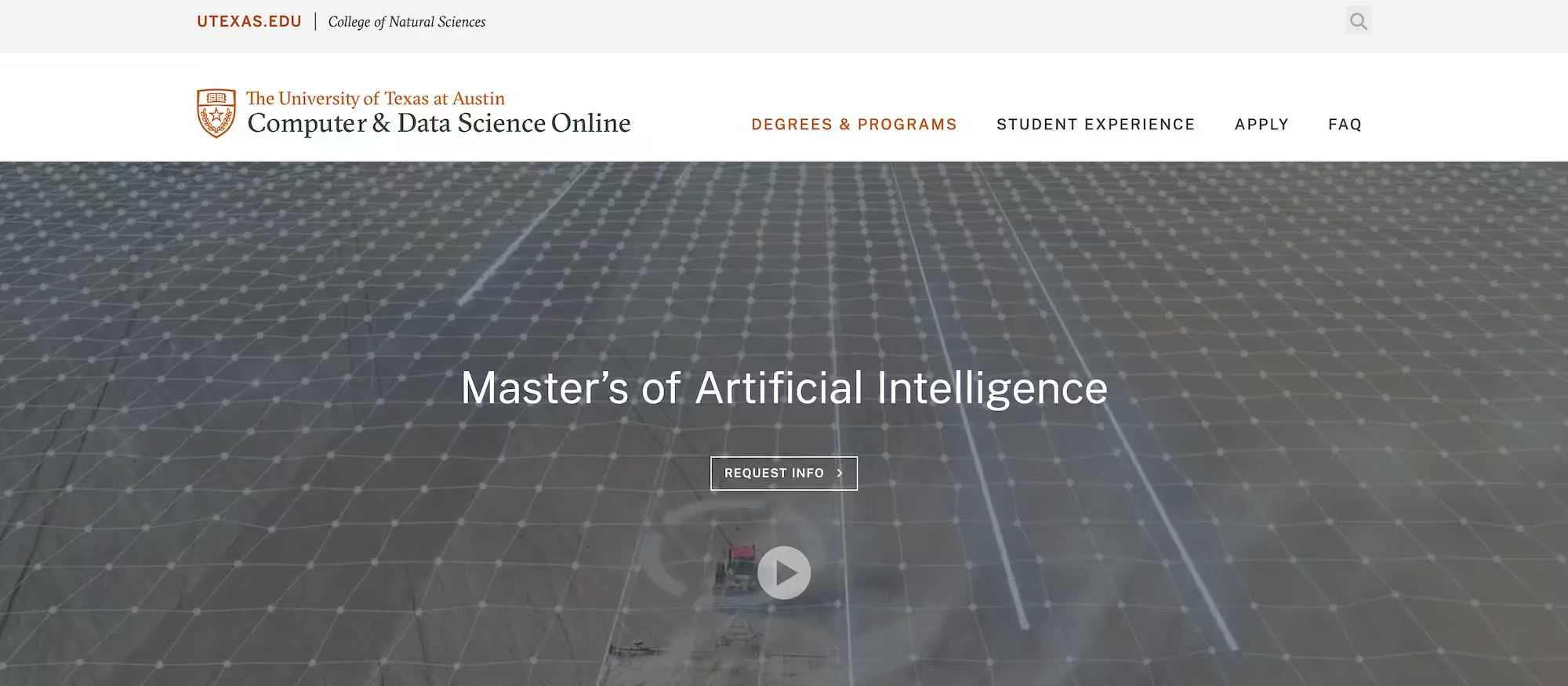
UT Austin delivers a full accredited master's in artificial intelligence for $10,000 in tuition, the same rate for in-state, out-of-state, and international students. The diploma reads Master of Science in Artificial Intelligence with no online designation on it.
The degree takes 30 credit hours, or 10 courses at $1,000 each: 3 hours of required coursework and 27 hours of electives drawn from a catalog that includes Machine Learning, Deep Learning, Reinforcement Learning, NLP, Deep Generative Models, Optimization, and applied tracks in healthcare and astrophysics.
- Cost: $10,000 in tuition, at $1,000 per course or $333 per credit hour. UT describes it as "$10,000 + Fees," and international student and late registration fees can apply on top.
- Duration: 18 to 36 months.
- Format: fully online and asynchronous, but instructor-paced. Lectures are pre-recorded and released weekly, with fixed schedules and due dates. Don't mistake it for a study-whenever program.
- Requirements: a bachelor's from an accredited institution. The GRE isn't required. There's no hard GPA minimum, though below 3.0 you'll need a Graduate School petition. Applicants without a technical background need coursework equivalent to discrete math, intro programming, data structures, algorithms, data mining, and linear algebra.
Worth knowing: UT publishes no career services for this program, so job search support is on you.
Best for: students who want an accredited AI master's on a working budget and already have the quantitative coursework to get in.
5. Georgia Tech OMSCS: best ML specialization inside a ranked CS degree
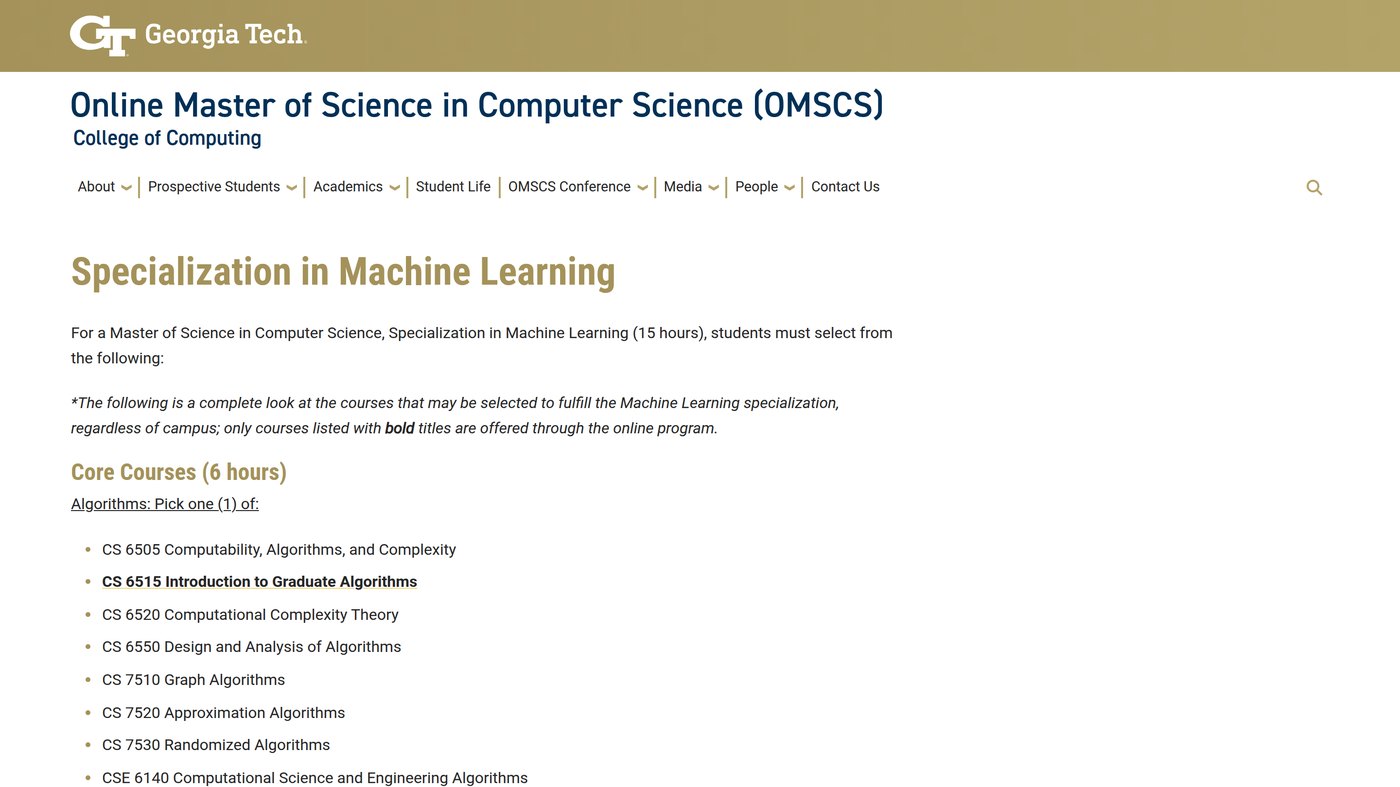
Georgia Tech's Online Master of Science in Computer Science carries the same degree requirements as the on-campus MSCS, and its Machine Learning specialization is one of six on offer. Total cost lands under $11,000 even for international students.
The specialization takes 15 of the 30 credit hours: one algorithms course, one ML core course (CS 7641 Machine Learning or CSE 6740 Computational Data Analysis), and three electives covering computer vision, reinforcement learning, deep learning, network science, and ML for trading. The remaining 15 hours are free electives.
- Cost: $227 per credit hour in-state, $236 out-of-state, $248 out-of-country, for 30 credit hours. Add an online learning fee of $212 a semester at under four credit hours, or $531 at four or more. All in, expect roughly $8,900 to $10,100 depending on residency and how many courses you take at once.
- Duration: six years maximum. Enrollment is part-time only, capped at 7 credit hours in fall and spring, so one course a term works out to a little over three years and two courses a term to under two.
- Format: fully online and asynchronous. All required courses and activities are delivered asynchronously.
- Requirements: a bachelor's from a regionally accredited institution, with a 3.0 undergraduate GPA preferred. No GRE. You'll need to pass two designated foundational courses with a B or better within 12 months of enrolling to continue. International applicants need TOEFL or IELTS Academic.
Worth knowing: unlike UT Austin's MSAI, OMSCS gives online students a dedicated career services manager through CareerBuzz, plus access to Georgia Tech career fairs and job boards. Admission is holistic and competitive, and Georgia Tech doesn't publish an acceptance rate.
Best for: engineers who want a ranked CS master's with a formal ML specialization and years of runway to finish it.
6. Stanford AI Graduate Certificate: best for coursework with Stanford AI faculty
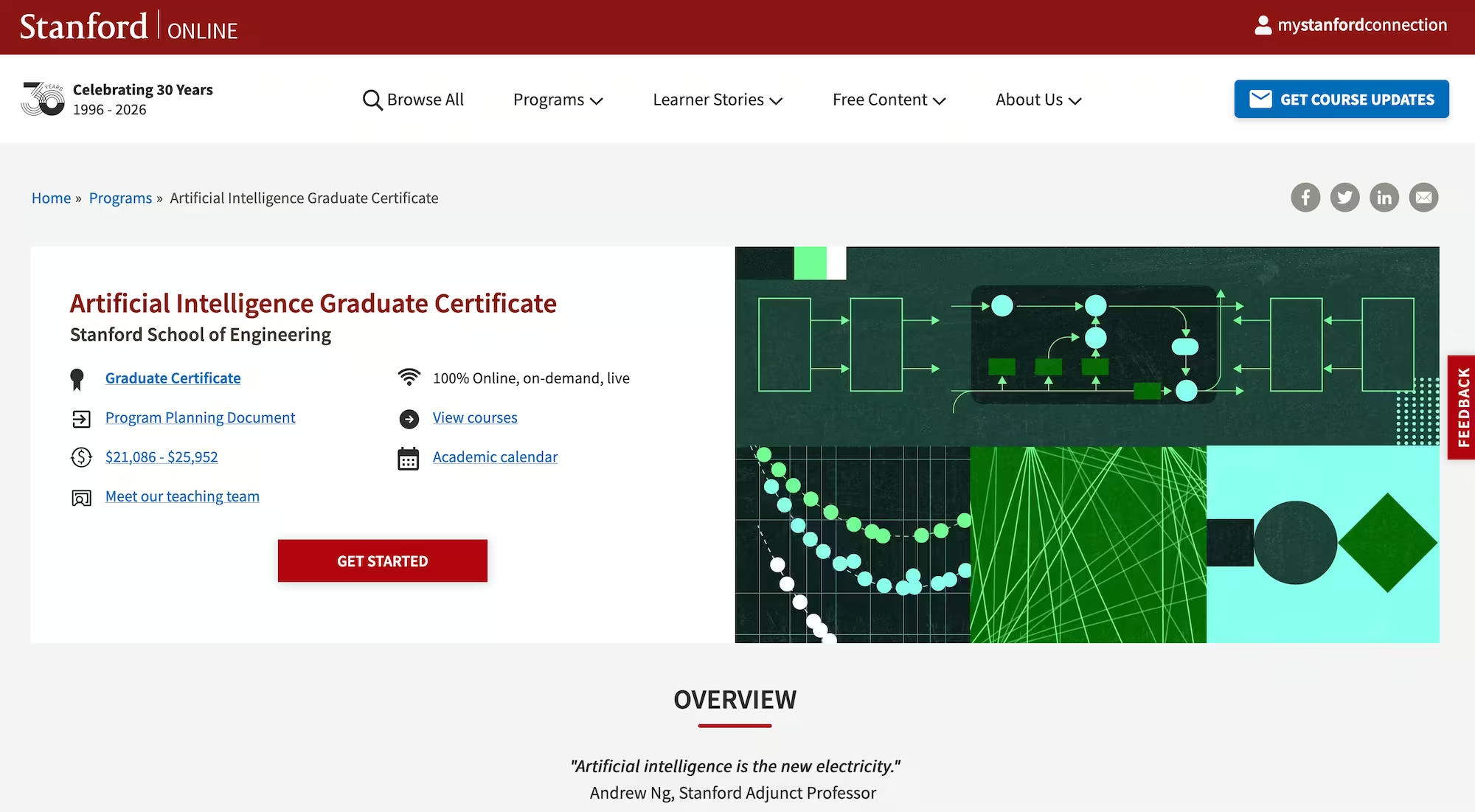
Stanford's AI Graduate Certificate puts you in four graduate courses taught by the faculty who shaped the field, including Andrew Ng, Christopher Manning, Chelsea Finn, Percy Liang, and Jeanette Bohg. You'll earn graduate credit and an official Stanford transcript, without applying to a degree program.
You'll take at least one of CS229 Machine Learning or CS221 Artificial Intelligence: Principles and Techniques, then fill the rest from about 22 electives, including CS224N for NLP, CS231N for computer vision, CS234 for reinforcement learning, CS336 for language modeling from scratch, and newer offerings in agentic AI and self-improving AI agents.
- Cost: $1,622 per credit unit, plus a one-time $250 document fee. Stanford lists totals of $19,464 for 12 units and $25,952 for 16. Because the CS department requires its courses be taken for the maximum units offered, most students land near $26,000. There's no financial aid for non-degree students, though GI Bill benefits and employer payment are supported.
- Duration: three academic years maximum, with most students finishing in one to two. Each course runs about 10 weeks and takes 15–20 hours a week.
- Format: online and on-demand. Lectures are taught live on campus, streamed, and recorded, so remote students watch on a roughly 20-minute delay. Courses are graded, and you'll need a B or better in each.
- Requirements: a conferred bachelor's with a 3.0 GPA, college-level calculus and linear algebra, probability theory, and programming experience. No GRE. The math prerequisites must appear as graded coursework on a transcript, while programming can be covered by work experience or self-study.
Worth knowing: up to 18 units can later count toward a Stanford master's if you're admitted and your department approves. There are no career services. Enrollment windows are quarterly.
Best for: engineers and researchers who want Stanford graduate credit and a possible on-ramp to a Stanford master's.
7. UW Certificate in ML & Deep Learning: best for graduate credit you can reuse
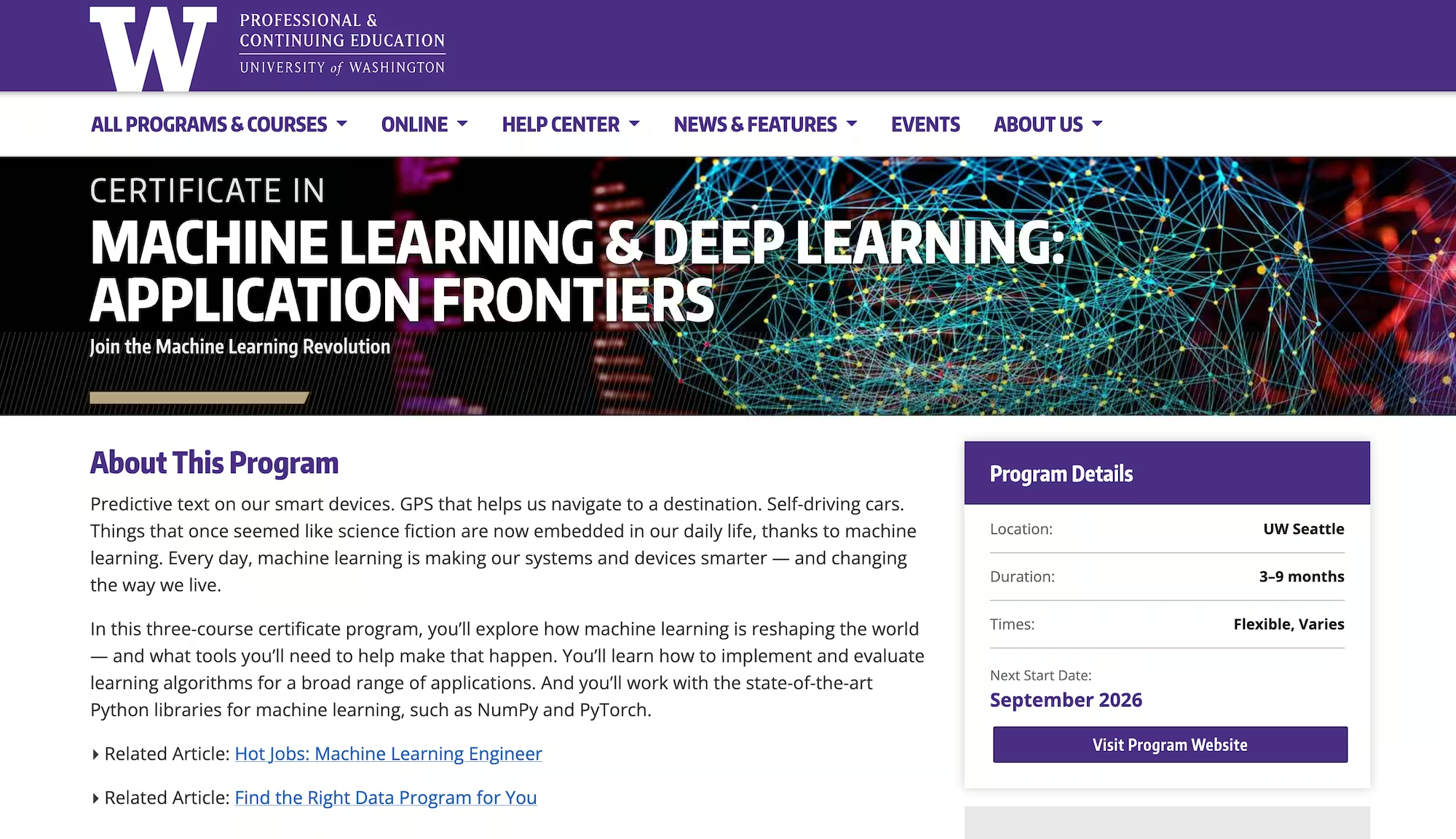
The University of Washington's Certificate in Machine Learning and Deep Learning: Application Frontiers is the only in-person option on this list, and the only certificate whose credits carry into a master's degree. All 12 graduate credits can count toward UW's Professional Master's in Electrical Engineering if you're admitted later.
You'll take three 4-credit courses chosen from the ECE professional master's catalog rather than a fixed sequence, so the syllabus tracks what's being taught that quarter. Autumn 2026 options include The Self Driving Car: Intro to AI for Mobile Robots, Deep Learning for Big Visual Data, Computer Vision: Deep and Classical Methods, and Foundations of Applied Deep Learning. Other quarters add Large Language Models: From Transformers to ChatGPT, Machine Learning for Cybersecurity, TinyML, and Privacy Preserving Machine Learning.
- Cost: $4,520 per class, or $1,130 per credit, at the 2026–27 rate. Add a $50 application fee, a one-time $75 graduate non-matriculated fee, a $55 registration fee each quarter, and a technology fee of $4 to $22 a quarter, for roughly $13,900 all in.
- Duration: one to three quarters, so 3 to 9 months depending on how many courses you take at once.
- Format: evening classes, in person at the UW Seattle campus. There's no online option, so this one only works if you're local.
- Requirements: a bachelor's degree, programming experience in Python, Java, C++, or C, and undergraduate linear algebra, calculus, probability, and statistics. Applications go in as a single PDF with a letter under 500 words, a resume, and official transcripts. You'll need a minimum 2.7 grade in each course to earn the certificate.
Worth knowing: UW publishes no career services or scholarships for this certificate, and it carries no Course Report or Career Karma rating, so there's no student review data to check. Applications are accepted quarterly and reviewed in the order received.
Best for: Seattle-area engineers who want graduate credit rather than a completion certificate, and who may go on to the ECE master's.
How to pick the best ML program for your career goals
Start with your current experience level, because it eliminates most of this list immediately. Here's how to narrow it down:
- Admission bar: working engineers can take any option here. Starting from zero, Simplilearn's certificate is the only entry with a built-in on-ramp, and even that asks for basic programming familiarity. Budget time for Python and linear algebra first.
- Weekly hours: the range across this list runs from 8 hours a week to nearly 30. A program you can't keep up with costs you the tuition and the time.
- Credential or portfolio: hiring managers for ML engineering roles tend to read GitHub. Research roles, visa sponsorship, and some large enterprises still screen on degrees. That distinction should drive your choice more than price.
- Career support and mentorship: TripleTen's accelerator offers the most, with a coach from week six and reviews by engineers working in tech today. Fullstack Academy comes next, with up to a year of 1:1 coaching after graduation. Georgia Tech gives you a career services manager. UT Austin, Stanford, and UW publish none.
- Deployment coverage: training a model is table stakes in 2026. Look for MLOps, LLM fine-tuning, RAG, evaluation, and agentic systems, because those are the skills in the job postings.
Start your ML career
Choosing a program is the hard part. TripleTen offers free career consultations for anyone weighing a move into machine learning, including an honest read on whether the accelerator fits your background or whether you'd be better served starting somewhere else.
FAQ
Do I need programming experience to enroll in an ML program?
For the programs on this list, yes. Every one of them asks for some programming background, and the degree programs also want linear algebra and probability on a transcript. Simplilearn's certificate is the most forgiving, with a Python refresher module built in, but it still expects basic familiarity. If you're starting from zero, spend a few months on Python and statistics first, or take an entry-level program in AI Software Engineering or Data Analytics before attempting ML.
What career paths open up after an ML program?
Graduates typically move into machine learning engineer roles building production systems, MLOps engineer roles deploying and maintaining models, applied scientist or data scientist roles, and the newer GenAI and LLM engineering roles working on RAG pipelines and agentic systems. If you're already an engineer, the most common path tends to be a lateral move inside your current company before a full job search.
Which ML programs still offer a money-back guarantee?
None of the seven programs here. Springboard removed its published pricing and no longer states a job guarantee on its machine learning track. TripleTen's AI & Machine Learning accelerator doesn't carry one either.
What should an ML curriculum cover in 2026?
Beyond the fundamentals of Python, statistics, and supervised learning, look for deployment and operations: containerization, cloud infrastructure, monitoring, and drift detection. Then look for the LLM layer, which means fine-tuning with methods like LoRA, retrieval-augmented generation, evaluation frameworks, and agent orchestration with tool use. Programs that stop at model training leave out most of what the job involves.

.avif)



.avif)
.avif)

