




There's a persistent myth floating around career forums and LinkedIn threads: that artificial intelligence (AI) is an exclusive club, reserved for PhD holders and computer science graduates.
If that’s true, then that club has a broken lock.
The talent gap in AI and the greater tech sector has grown so wide and so fast that tech firms like IBM and Google have publicly shifted to skills-based hiring, actively dropping degree requirements for thousands of roles. It’s part of a years-long trend of companies not caring where you studied. They care what you can build.
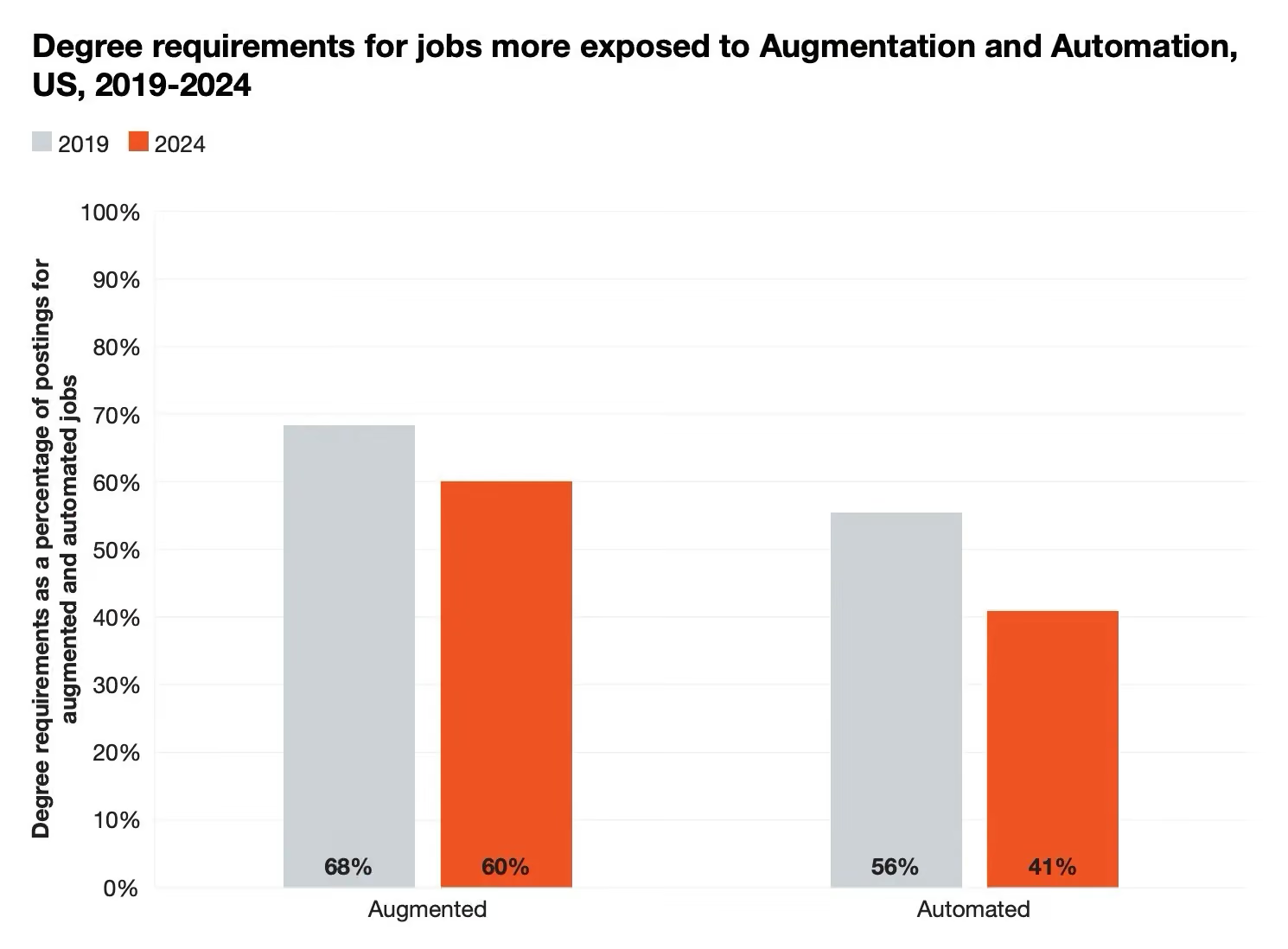
And the numbers back this up, too. Research by PwC shows that degree requirements for jobs that can be automated and augmented by AI have declined from 2019 to 2024 — a sign that employers are likely prioritizing skills over traditional qualifications. PwC also notes that AI-skilled workers commanded a 56% wage premium over their non-AI peers across industries in 2025—up from 25% in the previous year.
Simply put, the job market is paying for what you can do, not what your diploma says. If you're willing to learn the right tools and build the right portfolio, figuring out how to get a job in AI without a degree has never been more achievable.
AI jobs with no experience: The real entry points
Autodesk’s AI Jobs Report notes that roles like AI Engineer and Prompt Engineer have grown 143% and 136% year-over-year, respectively. These jobs exist, they're multiplying, and right now there aren't enough people to fill them.
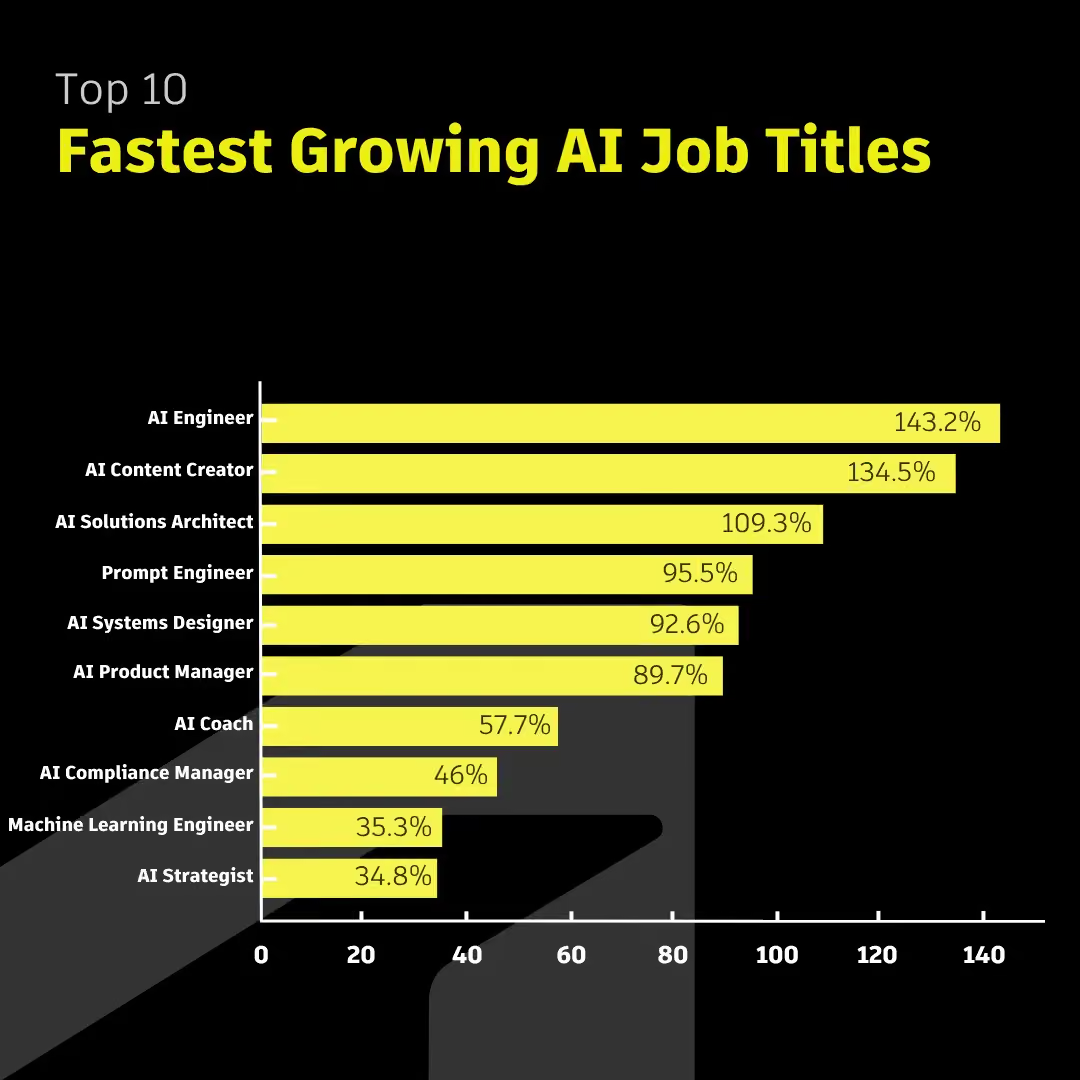
The good news is that you don't need to build a large language model (LLM) to work in AI. There's an entire tier of accessible, well-paying AI jobs with no experience required.
These roles are perfect for candidates with no formal background—think fresh graduates or career changers pivoting into tech.
There are currently two job categories with the lowest barriers to entry:
- Data annotation
- AI customer support and safety
1. Data annotation
Data annotation is often called the "blue-collar work" of the AI era, and there's no shame in that. Every AI model you've ever used, from a chatbot to an image classifier, was trained on data labeled by humans.
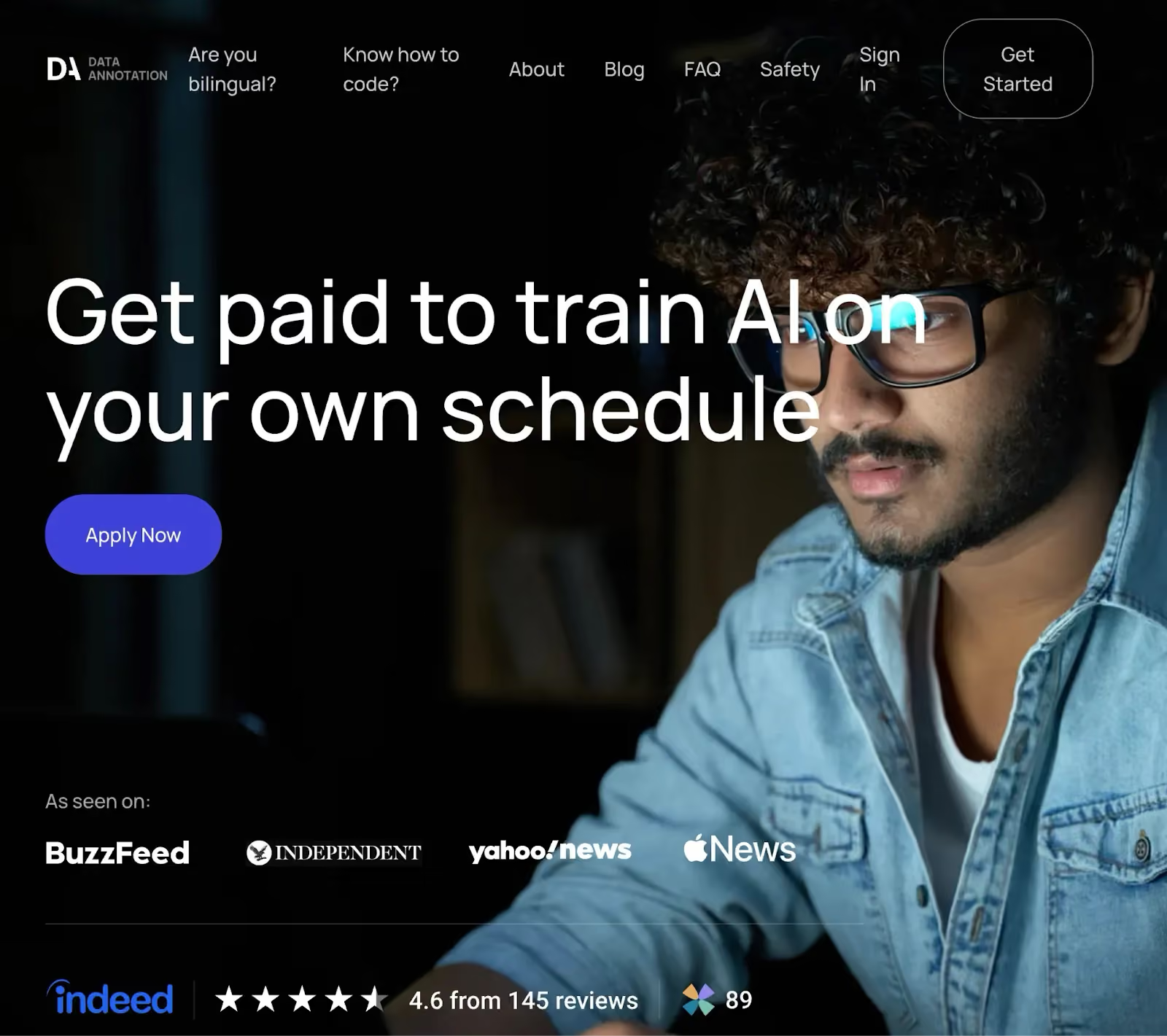
Platforms like Data Annotation, Outlier, and Mindrift are actively hiring experts to “train AI” by:
- Rating responses
- Classifying images
- Evaluating outputs for accuracy and bias.
These roles typically pay $20–$45/hour, require zero technical background, and can be done fully remote.
More importantly, they teach you how AI thinks from the inside out — think of it as a foundational soft skill specifically for AI.
2. AI customer support and safety
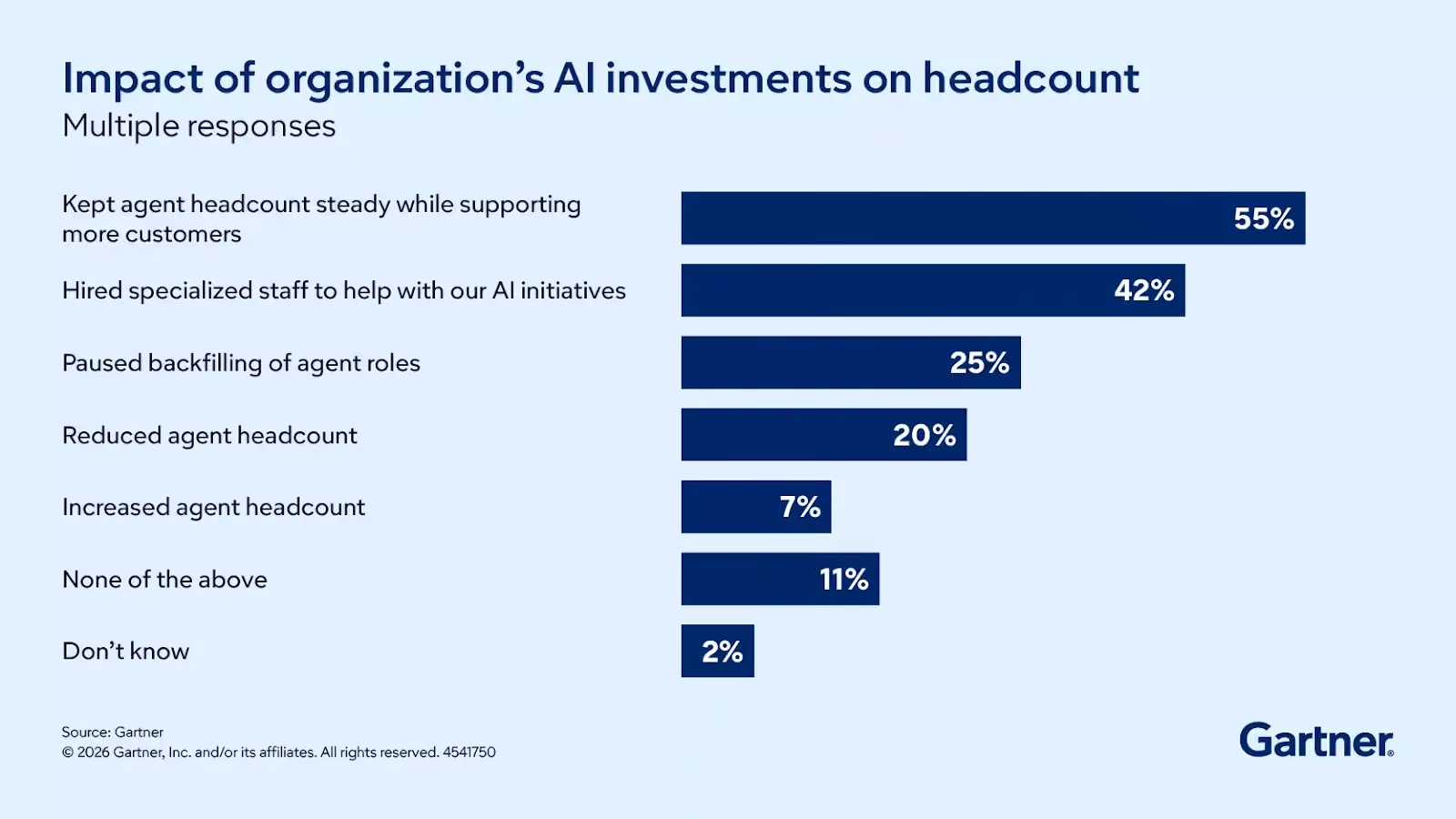
Customer support is widely considered one of the most vulnerable sectors to AI and automation. While Gartner’s research revealed that 20% of organizations have reduced their agent headcount, the firm also predicts a boomerang effect: 50% of companies that reduce their teams due to AI will rehire staff to do similar functions in 2027, but under new specialized titles, such as:
- Automation supervisors
- Escalation specialists
- AI trainers.
In other words, customer service roles are changing.
Companies deploying conversational AI need human evaluators to assess their chatbots for tone, bias, and real-world accuracy. These "AI safety" roles value qualities that algorithms genuinely can't replicate: human empathy, cultural nuance, and common-sense reasoning.
If you've worked in customer service, healthcare, or education, you likely already have the instincts these employers are looking for.
The bootcamp bridge: Going from annotation to integration
What to learn first: The tech stack for AI jobs without a degree
You don’t have to learn everything to build a career in AI. But you do need to pick up the right things.
Our AI bootcamp is designed to give you a focused skill stack that will make you employable in AI roles without a CS degree. These include:
Python
Start with Python, which is widely considered the universal language of AI. It's readable, beginner-friendly, and runs the entire modern ML ecosystem—from data wrangling to model deployment.
Where to start: Focus on variables, loops, functions, and libraries like Pandas and NumPy. Once you can manipulate data and call APIs in Python, you have enough to build meaningful things.
Workflow automation
Tools like n8n, Zapier, and Make let you build sophisticated AI-powered workflows (linking LLMs, databases, calendars, and CRMs) without having to write a single line of custom code.
Where to start: Look for small businesses that need help automating their customer follow-up with an n8n workflow. Document the before and after and add the story to your portfolio.
SQL
AI models need data to function. Knowing how to query the data that feeds those models makes you immediately useful on any AI team. SQL is one of the fastest skills to pick up (a solid weekend of practice gets you far) and one of the most consistently demanded skills in AI-adjacent job postings.
Where to start: TripleTen offers a free SQL bootcamp that dives into database administration, SQL queries, data analytics, and SQL for data science.
Vector databases
Vector database platforms like Pinecone and Milvus are the backbone of RAG (Retrieval-Augmented Generation) systems: the technology behind AI tools that can search your company's internal documents, knowledge bases, or product catalogs.
You don't need to be a database architect; conceptual fluency is enough to put you ahead of most applicants.
Where to start: Read the official Pinecone documentation. It's beginner-friendly and walks you through how embeddings and semantic search work without assuming any prior knowledge.
Build these skills to land an AI job without a CS degree
How to build an AI portfolio with no experience
The challenge when applying for an AI job without experience is that it’ll be hard to get anyone to believe you have the right skillset. But a GitHub repo with three well-documented projects? That speaks louder than any degree.
You don’t necessarily have to build something revolutionary. Instead, focus on demonstrating that you can take a problem, use the right tools, and ship something that’s actually useful.
Here’s how to do just that.
Project 1: The RAG pipeline
Build a chatbot that can answer questions about a specific set of documents, whether it’s a company handbook, a set of product manuals, or even your own notes.
- The technical details: Chunk your documents and generate embeddings using OpenAI or a free alternative like Sentence Transformers, store them in a vector database, and wire it up to a language model that retrieves the relevant context before answering.
- This project demonstrates: Embeddings, vector search, LLM integration, and practical problem-solving.
Project 2: The structured extractor
Use the Instructor library (built on top of Pydantic) to extract clean, structured data from messy PDFs or unstructured text and write it into a database or spreadsheet.
- The technical details: Pulling invoice line items from scanned PDFs, or extracting key facts from a stack of research abstracts.
- This project demonstrates: Real-world data wrangling, structured outputs, and the kind of "AI plumbing" that enterprise teams need constantly.
Project 3: The tool-calling agent
Build an AI agent that doesn't just answer questions but also actually does things. Connect it to a real API: have it check a calendar, create a task in a project management tool, or update a row in a CRM.
- The technical details: Use frameworks like LangChain or LlamaIndex to build an agent that takes a plain-English instruction and executes a multi-step real-world task.
- This project demonstrates: Agentic AI architecture, API integration, and autonomous task execution — exactly what "AI Operations Specialist" job descriptions ask for.
It’s time to start a career in AI with no experience
The barrier to entering AI is lower than you think. The real challenge is proving you have the skills to match job descriptions and actually get hired.
The good news is that every tool, library, and framework you need to build real, employable AI skills is either free or affordable. The path from "curious beginner" to "junior AI professional" has never been more clearly mapped. Start with one annotation gig, one Python tutorial, and one project in a GitHub repo. Then build from there.
Frequently asked questions
How do you get a job in AI without a degree?
Focus on project-based outcomes over credentials.
For starters, you can build a portfolio of two to three documented AI projects—a RAG pipeline, a structured data extractor, or a tool-calling agent—and host them on GitHub.
Many AI roles, particularly in operations, automation, and integration, explicitly value demonstrable skills over formal education. So yes, you can get a job in AI without a degree, but you'll need proof of work to back it up.
Are there AI jobs for beginners without a degree?
Yes. Entry-level AI jobs with no degree requirements do exist. Data annotation and AI training roles on platforms like DataAnnotation.tech, Outlier, and Mindrift are specifically designed for people with no technical background.
These roles pay anywhere between $20–$45/hr, are fully remote, and give you firsthand exposure to how AI systems learn, which is valuable context for moving into more technical roles later.
How do you start a career in AI with no experience?
Start with automation tools. Learning n8n, Zapier, or Make requires no coding background, and building AI-powered workflows with these platforms is a legitimate and in-demand skill.
From there, layer in Python basics, SQL fundamentals, and one or two portfolio projects. The key is to generate proof of work quickly, rather than waiting until you feel "ready."
How long does it take to get a job in AI with no experience?
Most people can become job-ready in 3 to 6 months with focused learning and consistent project work. At TripleTen, our bootcamps put you on an accelerated learning path running for at least four months.
Your timeline depends less on your background and more on how quickly you build a portfolio. Candidates who prioritize hands-on projects over passive learning tend to move faster.

.avif)
.avif)