



Can you afford a bootcamp?
Yes, you can afford a coding bootcamp. There's our anti-clickbait answer up top: one word, simple, confident — yes. Bootcamps cost money, no argument. There are also a lot of ways to pay for one — installments, loans, paying upfront, income-based options — and the math, when you run it, usually favors enrolling.
If you're committed to changing careers, you and the bootcamp you choose can find a way to make the tuition work.
Here's how to pay for a coding bootcamp, what TripleTen actually costs, and why the investment is worth running the numbers on.
How much does TripleTen cost?
Tuition depends on the bootcamp you choose. Here's the upfront pricing across our 2026 programs:
Upfront payment is the cheapest option. Installments and loans spread the cost out, which makes the monthly hit smaller and the total cost a bit higher. Income-based loans push the bulk of the payment to after you're hired.
Specific installment, loan, and income-share numbers depend on the program you pick and the plan length. A Career Advisor can walk through exact totals with you on a free call, and full payment-option details for each bootcamp live on the payment options page.
Can you afford not to join a bootcamp?
This part usually comes last — most articles about financing a bootcamp open with credit scores and loan tables. We'll get to all of that. First, though, the case for the investment.
Affordability isn't just a number on a tuition page. It's also a function of what you'd earn over time. Based on our Student Achievement Highlights, not joining a bootcamp is often the more expensive option once you factor in the earning potential you're leaving on the table.
Here’s what we mean — take a look at this info on our Software Engineering Bootcamp grads.
Our Software Engineering grads came to us earning a median salary of $55,000, so we set that as the baseline for both the career switcher and the person staying put.
But in the first year following the pivot, the person switching sees their earnings skyrocket by $15,000 when they begin a new career in tech. In contrast, we estimated that the non-switcher would only increase their earnings by 3%, the average yearly raise.
Now factor in the cost of the bootcamp. After all, it isn't free.
This assumes that the person who enrolled chose one of the most expensive ways to pay for the bootcamp: using our longest installment plan (prices current as of the writing of this article). For full transparency, there are loan options that can cost more, but we can’t give concrete data on their totals, as interest rates can differ case by case. For the sake of having hard numbers, we’ll be using the longest installment plan figures as our benchmark.
So, the hypothetical person who didn’t switch might be feeling pretty pleased with their decision to stay put. After all, in terms of return on investment, they increased their earnings by $1,650 by doing nothing. True, the bootcamp cost ends up covered by the salary increase, but in year zero, the education eats up all but $430 of the earnings boost (and we’re putting the costs in year zero for the sake of ease of comparison even if, indeed, the example is assuming an installment plan that will be covered over a longer timeframe).
To illustrate this, let’s give the person choosing to stay put the best chance of competing.
We’ll say that they change jobs every three years, earning a 20% increase with each new position. We’ll also give them a boost and say they switched jobs at year zero and earned a 20% raise instead of the average 3% raise we’ve been using above.
And we’ll leave the year zero earning potential for the switcher diminished by the bootcamp cost. After all, the bootcamp is an expense incurred only when shifting careers.
For a bit of explanation: we’re using the three-year switching schedule because it provides a good comparison to Glassdoor’s stats on software engineers and their earnings relative to their experience (data current as of the writing of this article).
So, explanation over. What does this look like?
Even with a 20% raise the first year and every three years thereafter, the person staying put doesn’t crack a six-figure salary until year seven. The person who switched to software engineering? They land six figures by year three. And yikes, y’all. The gulf in what that means in terms of total earnings is shocking.
The bars themselves don’t look all that striking until you realize that the difference between them totals to $216,695. That’s half the median price of a house.
This also assumes that you are the average person, which, of course, you aren’t. It doesn’t account for the fact that you could specialize and land a lucrative tech job that might even pay you up to $269,917.
See, education is an investment that doesn’t depreciate. Tuition is paid back many times over across a career — and once it's repaid, the upside compounds.
We'll get off our soapbox now. Things cost real money in the real world, we know. So let's get into the actual mechanics. The future's promising; the question is how to clear the first financial hurdle.
How to pay for a coding bootcamp
Just so we’re on the same page, we’re going to be using our AI Software Engineering program as the example for bootcamp costs. This will give you a sense of what the different payment options look like without overwhelming you with information. If you want more specifics on what different programs cost and the nuances of payment plans, you can find details here. With that out of the way, let’s talk about four common ways of covering bootcamp tuition.
Paying upfront
No surprises here. Paying upfront is the cheapest way to cover bootcamp tuition — $9,800 for AI Software Engineering, and less for the shorter programs (see the table above). One lump sum, no interest, no debt, no impact on your credit score.
Installments
This breaks down the total cost into monthly payments made during and after your time at a bootcamp. If you choose to go for installments with our lending partner, Lumion, this schedule can last from 6 to 24 months.
This approach relieves immediate financial pressure, but ends up more expensive in the long run. Returning to our example: for the longest 24-month installment plan, the initial deposit would be $1000, and the monthly payment would be $706, but the total cost for the AI Software Engineering program would grow to $17,950. Going for shorter installment plans would lower this total cost.
Bootcamp loans: financing through Climb, Fortify, and Edly
If you’re familiar with student loans, then you’ll likely have no problem grasping bootcamp loans. The one caveat we’ll add here is that the debt you take on with these loans is far less than the debt you’d assume to cover tuition at a four-year institution.
For our AI Software Engineering program, the total base cost with loans arranged through Climb would be $17,950. However, like we hinted at above, this might not be the total amount you’d end up paying, as interest will accrue, and the exact amount will depend on your specific situation. Still, this is significantly lower than the average $38,375 of student debt people take on for college.
So this might be the way to go if your credit is solid and you’re confident in your ability to make monthly payments.
Income-based loans (income share agreements)
These come in multiple forms, but the basic philosophy of this method of financing a bootcamp education is that the bulk of the payment will start only once you land a job meeting certain criteria. Some of these contracts might come with requirements to make smaller payments during your time studying as well.
Now, that sounds fairly similar to installments and loans so far, so we’ll just underline the key difference: the vast majority of this payment will be contingent on the job you get once you graduate. The specific amount will be based on the fixed percentage of your salary that you agree to pay after landing a job and the period over which you agree to pay it. In addition, some of these income-based loans can accrue interest.
This means that you’ll spend relatively little to gain the education to make a career pivot. In addition, this setup incentivizes bootcamps to ensure their students get jobs. After all, grads will only start tackling the bulk of the payment once they get a job meeting the stipulated criteria. However, the percentage and period can combine to lead to you paying far more than you expected.
This is a fairly complex topic, so we encourage you to read more about it to see if it’s right for you.
Bootcamp financial aid, FAFSA, and scholarships
A common question we get: do bootcamps accept FAFSA?
Short answer: most don't. Federal financial aid (Pell Grants, federal student loans) is reserved for accredited institutions of higher education. Most bootcamps, including TripleTen, are not federally accredited and therefore aren't FAFSA-eligible.
That doesn't mean financial aid is off the table — it just looks different at a bootcamp:
- Bootcamp lender financing. Climb, Edly, and Lumion fill the role federal loans play at universities — accessible terms, designed around bootcamp tuition amounts.
- Income-based loans / ISAs. Pay little or nothing upfront; pay back a percentage of your tech salary after you're hired.
- Employer reimbursement. Some employers reimburse upskilling costs, especially if your new skills connect to a current or future role on their team.
- Scholarships and tuition assistance. Eligibility depends on background and circumstances. A Career Advisor can walk through what's available — book a call to discuss options.
- Veterans benefits and SkillBridge. Service members transitioning to civilian careers have additional pathways worth asking about directly.
If federal aid is a hard requirement for you, an accredited college program will be a better fit than any bootcamp. If "what's the smartest financial path into tech" is the question, the bootcamp model — with shorter timelines, lower total cost, and faster employment — is usually the answer.
What your tuition covers
At a bootcamp, students pay for much, much more than just professional education. Yes, gaining programming skills is key to the experience. But there’s so much more included, too. For example, rather than just giving students know-how in hard skills such as coding, good bootcamps include training in soft skills as well.
After all, as shown by our employer report that surveyed over 1,000 decision makers, 68% of respondents said that hard skills were paramount for an applicant’s success. Just behind that, 65% said soft skills were also crucial.
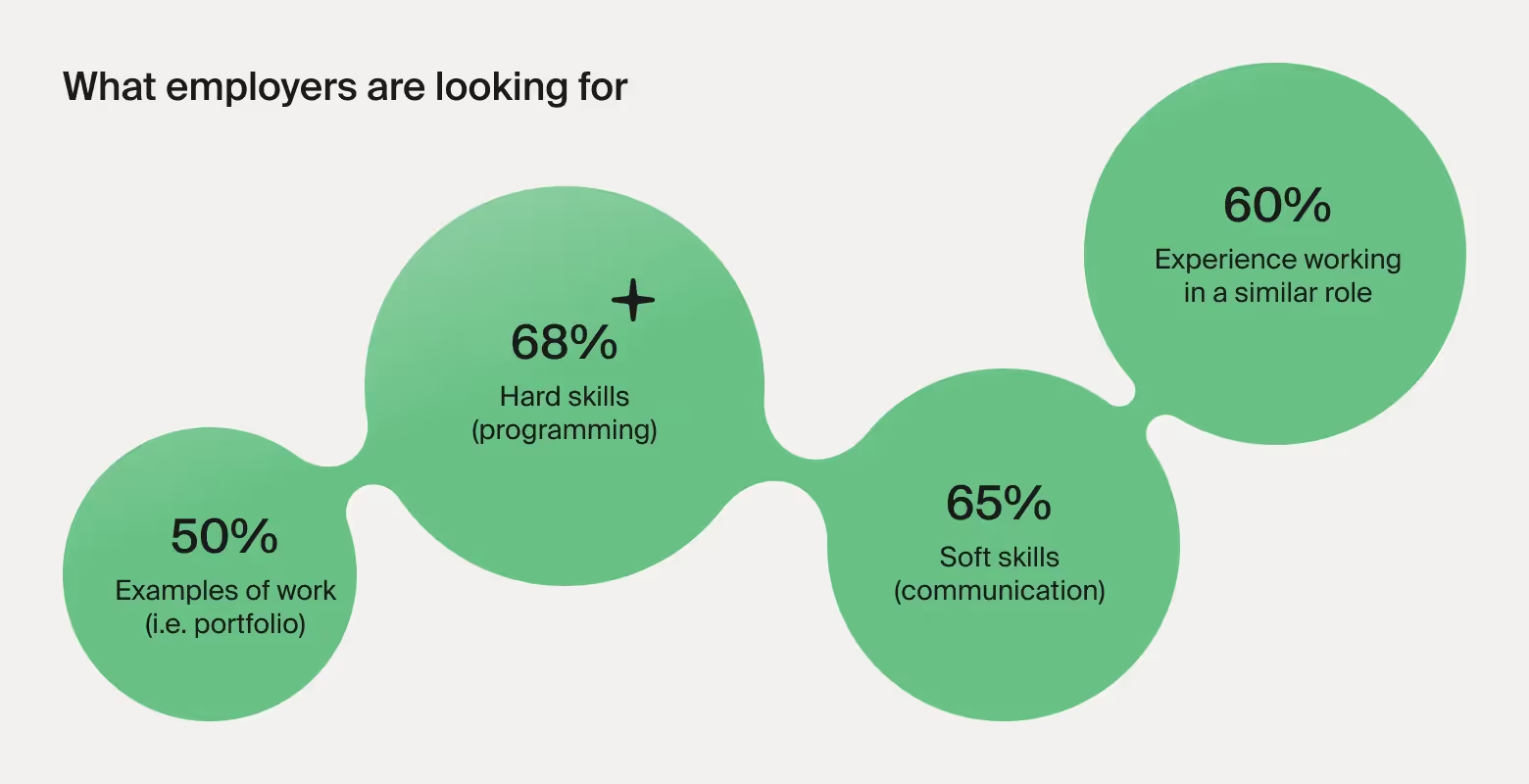
So we teach both. In our AI Software Engineering bootcamp, industry experts teach in-demand languages and frameworks — including JavaScript. The structure of the bootcamp itself simulates real tech work, which builds the soft skills employers care about: communication, teamwork, problem-solving.
It doesn't stop there. Tuition also gets you a shot at your first piece of real tech experience through externships — actual projects with real companies that students can apply to as the bootcamp wraps.
You learn what working in tech actually feels like, and you walk out with the first entry on your tech portfolio.
Pro tip: per our employer survey, a strong portfolio is one of the biggest signals to hiring managers that you're worth a callback.
The externship projects are also genuinely interesting work.
- Our students built a dashboard for the Boston Public Library to schedule events and staff hours more effectively.
- They rebuilt a website for Synthesis Workshop, a platform that makes science content more accessible.
- They refined the user journey for Kippy, an AI-powered language-learning app.
Don't pay until you get a job: our money-back guarantee
A version of "don't pay until you get a job" is exactly the structure behind our money-back guarantee. Strong bootcamps offer a guarantee like this as a signal of confidence in what they're building.
Our guarantee is simple. Finish the bootcamp, follow the advice your instructors and career coaches give you, stick to the program guidelines, and if you don't land a tech job within 10 months of graduating, your full tuition is refunded.
For most students, the guarantee is a backstop they don't need to use. Two out of three of our grads land a tech job within 10 months of graduating, and 80% of them came in without a tech degree. The guarantee is there because the outcomes are real — and because we want to take the risk off your shoulders if life doesn't break the way we both expect.
Worth saying clearly: the options on the table are a tech career or your money back. That's pretty affordable.
See if a bootcamp is right for you
If you want to make sure that a bootcamp will be the best way for you to gain new tech skills to make a career change, we’ve got just the thing for you. Discover if a bootcamp is right for you by taking our self-assessment quiz.