





How do you know if your job has gone from stressful to fully toxic? Maybe the decline started with an inconsiderate scheduling change. Maybe it continued with worsening management that you accepted because hey, you needed the money. Maybe, over a decade in, you now don’t even notice that the work is unhealthy because after so much time, it’s become normal.
The thing is, we all have judgment. And at one point, you’re going to realize how unacceptable the situation is. Khalid Ipaye did.
He was a sergeant in the Oklahoma Department of Corrections, where he’d verbally deescalate confrontations with inmates when he could, and physically defend his colleagues when necessary. Too often, his hours kept him from seeing the sun. And all of that was just part of the job. Then, one morning, it hit him: he needed to make a change.
So, if you find yourself in a similar situation to his, what should you do? Easy: follow his example. Here’s how he enrolled in TripleTen, learned new tech skills, and is now working a job that is healthier, safer, and most important of all, finally bringing him peace.
A toxic, dangerous career
Khalid was 30 hours away from finishing an engineering degree when he decided college wasn’t for him. Instead, he entered the workforce, which ended up bringing him to the Oklahoma Department of Corrections. Over 12 years, he rose through the ranks to the level of sergeant, but the accolades came with real downsides. First of all, despite the state’s best efforts, drugs made their way inside the prison.
“Drugs are heavy in prisons,” Khalid said. “And a lot of those guys fell under the influence. And it got to a point where I had to take care of these guys. And who’s protecting me?”
He was the one who had to come in when an inmate was using and not in his right mind. “I normally knew how to talk to people, but it wasn’t just me as an officer there,” Khalid said. “Other officers didn’t know how to talk to people.”
Sometimes, that led to fights, and Khalid would need to come in and defend his fellow officers. “I’d have to get involved in the fight as well because I needed them to go home safe.”
On top of that, he was working nights fairly often.
You're working from 4:00 p.m. to 4:00 a.m., which means you don't see the sun at all. And I was doing that quite a bit. Khalid Ipaye, TripleTen grad
The thing is, even with all this, he kept working under these grueling conditions, staying the course. Then, internal politics came in. Ignoring proper procedure and despite Khalid having only one write-up in his 12-year career, the DoC demoted him. He got a lawyer and got his position back, but it brought him to a realization.
I woke up and realized, 'Hey, I'm better than this.' Khalid Ipaye, TripleTen grad
A relative of his in cyber security had been encouraging him to switch to tech, but Khalid hadn’t given the pivot all that much thought. After the demotion fiasco, he was eager to make the change, so he asked for a reminder of the program his relative had been recommending: “I was like, ‘Hey, send me that link again,” Khalid said.
It brought him to TripleTen.
Correcting course with new know-how
Khalid chose to enroll in TripleTen’s Quality Assurance (QA) program because it was the one that was most realistic for him financially. In addition, he had no illusions that he was the world’s most adept computer user, admitting, “I really was terrible at using computers.”
So the QA program’s affordability as well as its accessibility sold him. Now, that’s not to say that he didn’t have to work to master QA. Some topics really asked him to study hard, such as when he was introduced to Python, but his dedication paid off: “Python was kind of rough for me, but I caught on. It just took a while.”
And “dedication” is the right word for how he approached his learning. See, for much of his time studying at TripleTen, he was still working long shifts that would occasionally finish at midnight, and only then would he have time to get to the new material. But even at that late hour, he could reach out to a tutor who would help him with anything he had questions about.
Even with me getting off of work at 12:00, there was somebody up that worked in the middle of the night from 12:00 to 2:30. Khalid Ipaye, TripleTen grad
By staying committed to the learning and reaching out when he needed help, he got himself ready for an externship, an opportunity to join a hands-on tech project with a real-life company. As part of this, he and his fellow newly minted QA experts tested TaskTrain’s site, making sure it was both functional and easy to use. Khalid’s role was specific: “I was working to see if they could upload pictures. That was my part in the project.”
It showed him what working in tech would look like once he landed a job, and it provided him with know-how that would end up being crucial. “Once I got to the externship, I understood more about exploratory testing,” he said.
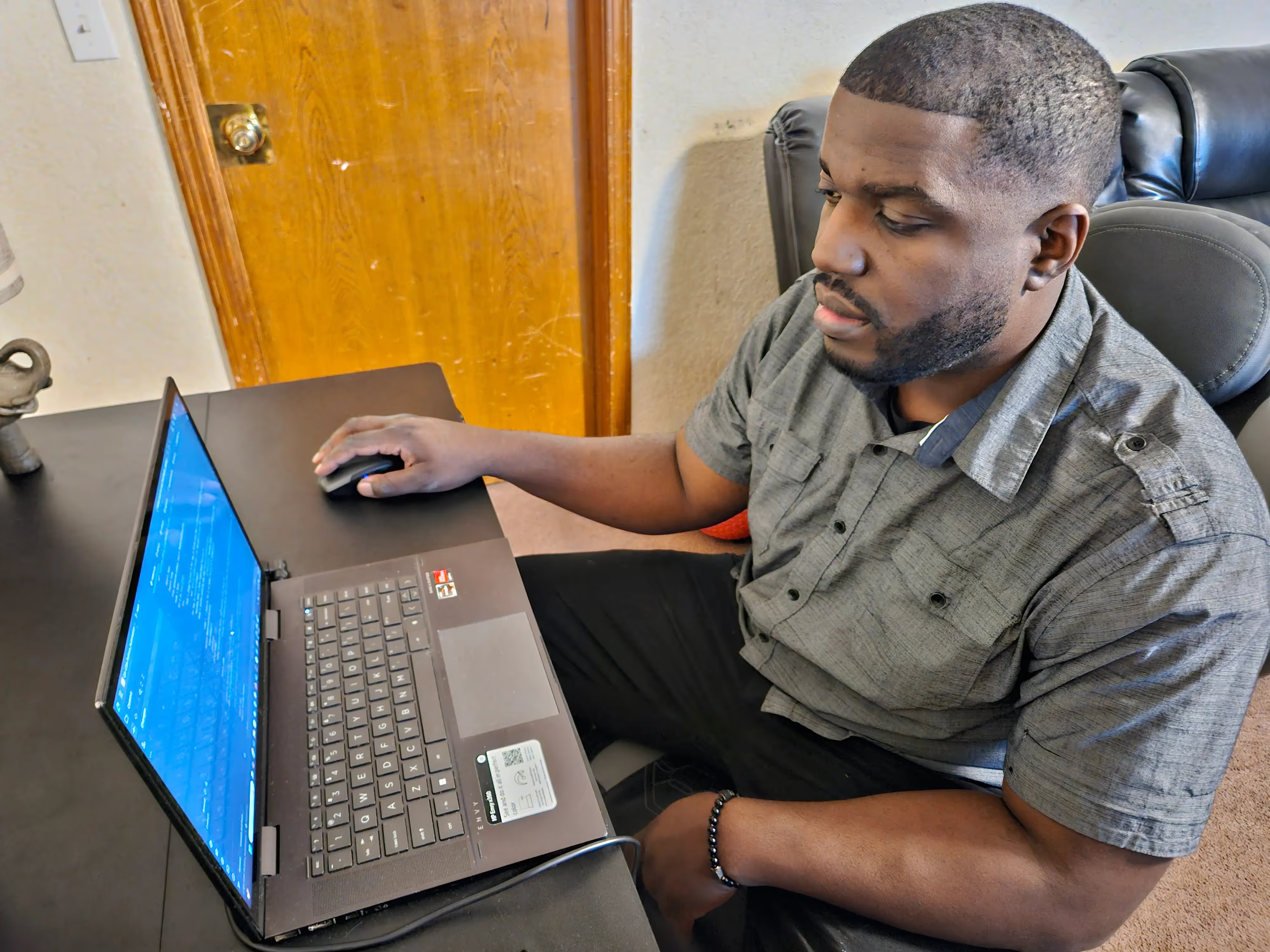
In addition, he built up a community of fellow techies he discovered he could rely on, and the cooperative nature of the externship showed him how enjoyable working with others on tech projects could be. “It was fun collaborating with other people,” he said.
But not only did he gain get-hired capabilities; he also got career coaching that made sure he could properly put his new skills on display in his portfolio and resume, something he’s still appreciative of. “They helped me build my resume back up because I had worked for DoC for 12 years, and my resume was dusty,” he said.
With his resume refurbished, he started applying. And it only took three months for him to land his new job.
A career back in the sunlight
Khalid had been focusing his efforts on job hunting on LinkedIn when he decided one day to switch to Indeed. While he was scrolling through, looking for the QA role for him, one vacancy stood out to him. He applied, and within 24 hours, he heard back from the company. They wanted him to come in for an interview. During that conversation, he leaned on his prior experience as well as the new knowledge he gained at TripleTen.
They saw that I knew the subject matter because of the work I’d done with TripleTen on top of the stuff I did with DoC. Khalid Ipaye, TripleTen grad
Three weeks later, he was hired. Now, he’s a Test Technician at QualityLogic, a company that does on-demand testing for other institutions. The exploratory testing he became familiar with during his externship has been crucial, as that’s a fair chunk of what he’s doing now within his current project: finding and reporting bugs for a financial website.
He comes in. He does his work. He leaves at the end of the workday. He gets to see the sunlight, and he’s no longer asked to physically defend his colleagues or deescalate tense situations. It’s been a major change that he appreciates.
It's peaceful, and that's really what I'm about more than anything, just peace of mind. Khalid Ipaye, TripleTen grad
The toxic politics are gone as well. “I like the people I work with. My boss is probably one of the coolest bosses I've had,” he said. And because he now has a more reasonable schedule, he has time for the things that matter: “I get to spend more time with my family, which is something I really wasn't doing a lot of.”
Now, looking back on it all, he sees how crucial TripleTen was for this transformation: “I feel like the program definitely helped me find a job that I can find peace at, and I'm very grateful for that.”

.avif)