




There’s an irreconcilable problem with the chain of causality: it can only be understood backwards. Sure, a future can be imagined and worked toward, but the concrete, specific actions leading from point A to point B can only be fathomed in retrospect. And then, when you do look back, everything seems inevitable.
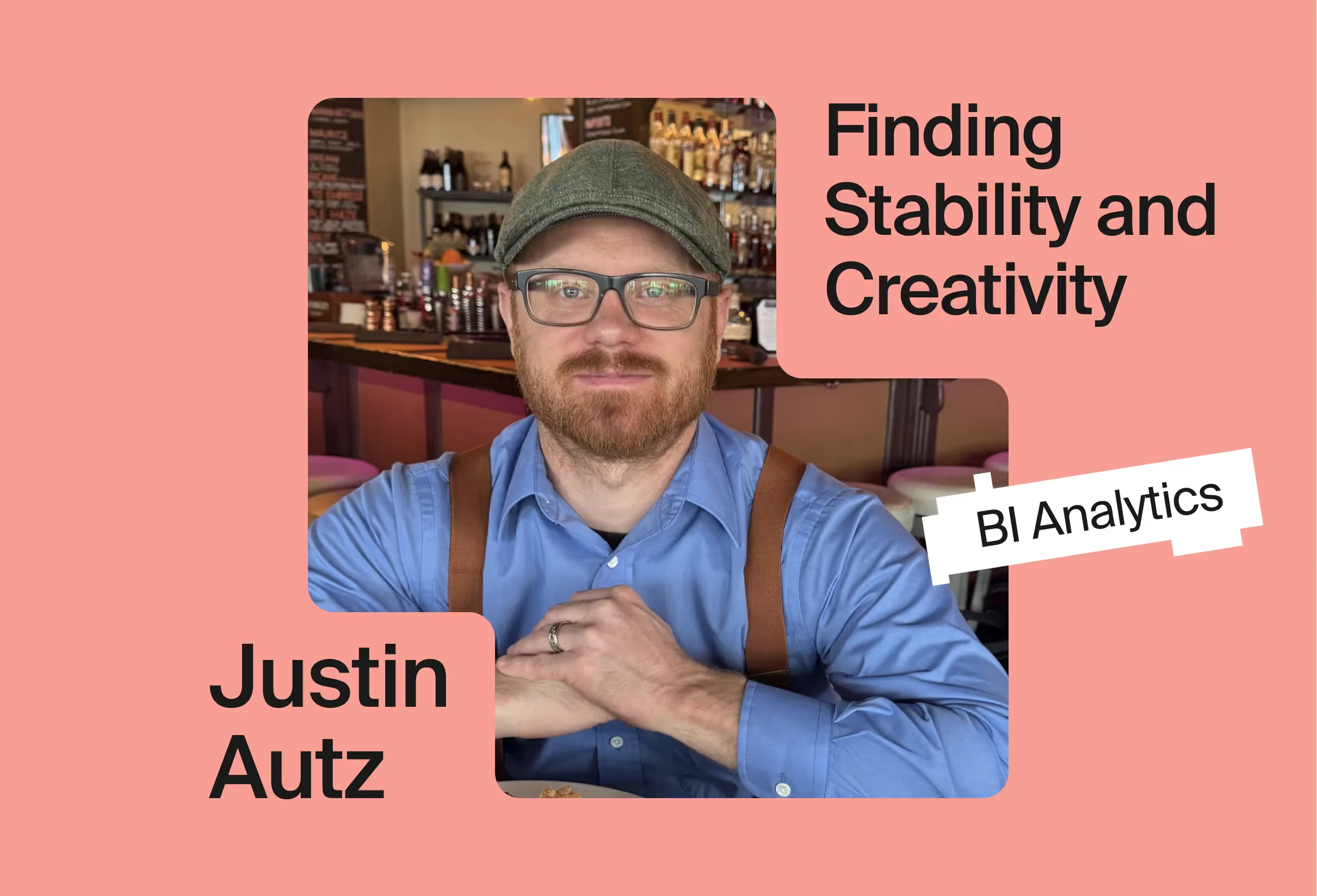
For Justin Autz, this is absolutely the case; his story makes a career in data seem like it was preordained for him. But when he was tracking turtles, when he was working construction, or when he was making TikTok and YouTube videos about Pokemon ROM hacks, he didn’t know that he was being set up to become a strategy analyst.
He did know that he had a desire for stability and creativity in his career, and by letting his core values guide him, he ended up in a role that now seems predestined.
Want to also look back on how following your principles couldn’t help but change your life? Follow his example. Here’s how he transformed his skills with TripleTen and landed the job that was waiting for him.
From construction to conservation and back home
Justin finished college with a degree in graphic design, but instead of creating logos for work, he instead went into construction, where he stayed for four years. That interest faded, too, though. “I developed a fascination for animals and conservation,” he said. “I went down to Costa Rica where I studied jaguars and sea turtles for six months and just fell in love with everything down there.”
So with that new interest fueling him, he returned to college and got a second degree in conservation and environmental science, and that formed the basis of another years-long career that took him around the country to study wildlife. This was his first taste of data analysis, but he didn’t know how perfectly it was setting him up yet: “I was collecting field data on population demographics, bringing it back, cleaning it up, organizing it, setting up models and experiments and then ultimately writing reports, and that became really fun for a while.”
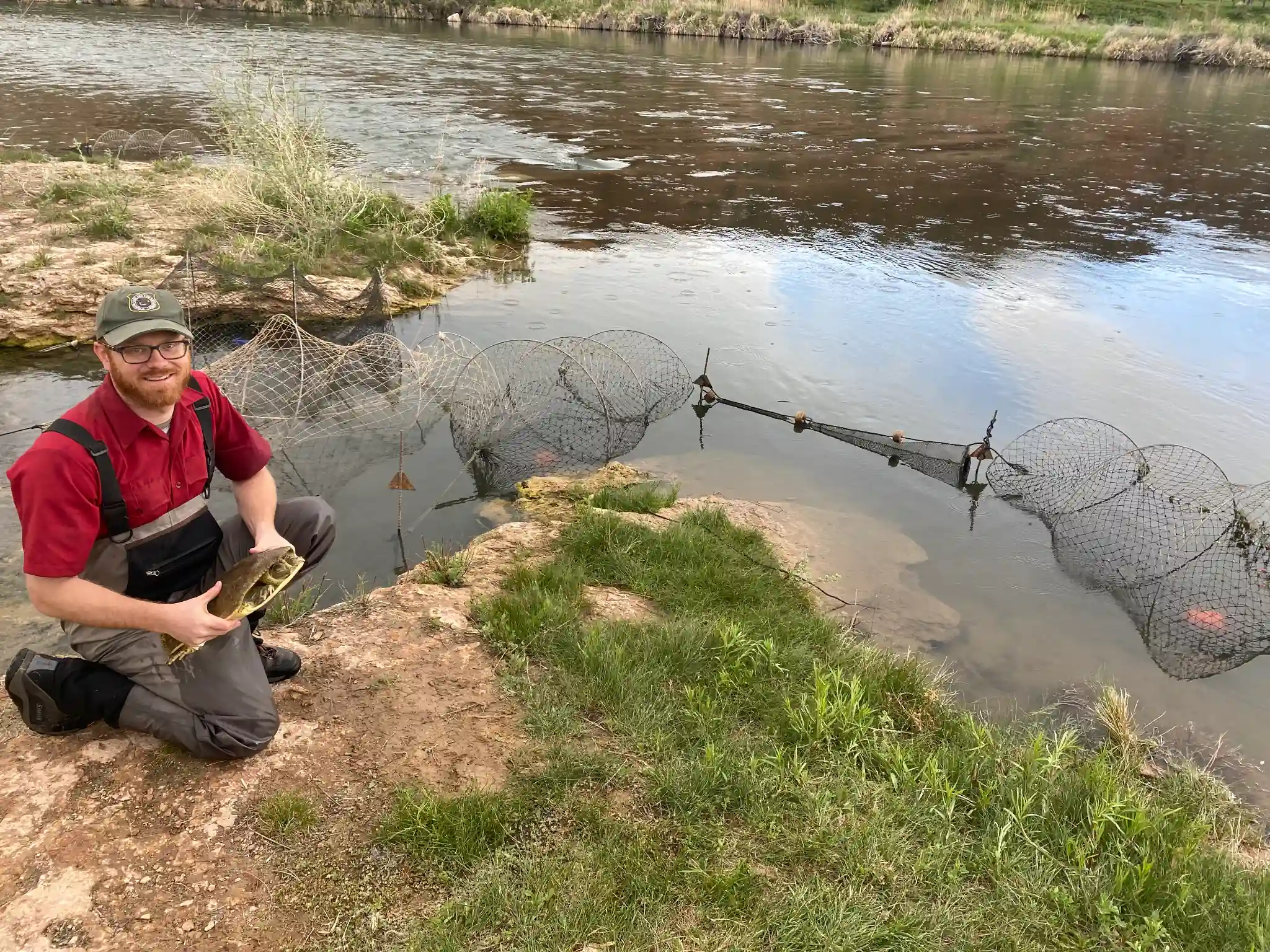
It was a job that inspired him. He even led a project studying the eastern spiny softshell turtle that covered 17,000 square miles of river in Wyoming, but that career path had a problem.
I couldn't really find a lot of work that was consistent and was paying enough to support life; especially moving around constantly made it really difficult. Justin Autz, TripleTen grad
“Obviously nobody's making money in conservation,” he continued. “So you have to rely on grants from the government.”
Making things more challenging was the fact that he’d focused on herpetology, and that was what potential employers were looking to hire him for, but he’d returned to his home state of Wisconsin, and the field wasn’t very lively there. “You can't find localized jobs for that. In Wisconsin, they don't exist where I live now; they're not here at all,” he said.
He had another option, though. See, in Wyoming, he’d started making YouTube and TikTok videos, and they’d done well. In fact, they were doing so well that when he landed back in the midwest, he committed to content creation full-time.
It meant he no longer had to keep relocating for work, but after just under two years, that career was no longer fulfilling. Worse, he couldn’t rely on any sort of steady income. “I was doing my content creation work, and it was so inconsistent,” he said. “That was the worst part about doing the content creation. I didn't know how much I was going to make [each] month.”
It mattered even more because, in short succession, he soon achieved two major life milestones. First, he got married. “It was a fairy-tale, story-book wedding. We met and got married within a year,” he said. Second, “We got a house within that time period, too.”
With that loan to pay off, the unpredictability of his income got him questioning: “Can I cover the mortgage? I don't know. Probably. But you don't want to bank on that. So you lose that peace of mind.”
Some months I'd make a ton of money. Some months I'd make very, very little though, and I was like, ‘I want to have something more stable, especially if me and my wife are going to live together.’ Justin Autz, TripleTen grad
So he got to researching. He remembered the work he’d been doing during his time in conservation and let it lead him: “I missed the science that I was doing, and I missed being able to uncover mysteries because that's what I like to think of the work that I do. I take data, and I figure out what's going on with it. It's like a detective case.”
That brought him to learning how to retool his know-how for business. He could have gone for a doctorate, but “didn’t want to go through the hassle of that.” He could have also gone for smaller individual courses, but knew they wouldn’t put him in touch with people experienced in the industry. He needed something that would be effective and fast.
I was in a scenario where I was kind of running out of work and I was like, ‘I need something that's going to be more affordable, something that I can actually pay for and get done quickly.’ Justin Autz, TripleTen grad
As a content creator, he’d made an ad for TripleTen, so he looked into the bootcamp. “TripleTen, based on all the reviews that I read, seemed like one of the best ones out there,” he said. “I explored all the bootcamps and different university offerings and then circled back around to TripleTen again and I was like, ‘This is the one I want to do.’”
Retooling his data know-how
From the start of his time in TripleTen’s Business Intelligence Analytics (BIA) program, Justin appreciated the educational approach: “The best part about it is all the directions were great, teaching me to get to the point where I need to go, and then at the end you have your capstone for that chapter and boom, it's full creativity.”
He could take his know-how and use it as he wanted. But more than that, with each new subject he was learning, his skills were being directly connected to what he’d end up doing in tech. “I was taking a real-world business problem and solving it while also going through the steps of learning how to solve it. And I think that was such a great two-for-one moment where I didn't have to learn it separately and then apply it to the business world. I could do both at the same time.”
That’s not to say every subject was completely easy to master, though. Coding was never his thing. In fact, he’d originally thought of going for the AI & Machine Learning program, but knew it was more programming-heavy than BIA. Still, as part of the BIA curriculum, he needed to get a handle on SQL.
As he predicted, had to work harder to master it. “I got stuck many times where I was like, ‘What is wrong with this code? I cannot figure it out.’ And that was frustrating because I'd always just be one little thing away — I forgot a comma or something like that.”
Dot, TripleTen’s AI assistant for students, helped him out:
[Dot] was able to look at my code and tell me exactly what I might need to do next, and it didn't give it away for me. Justin Autz, TripleTen grad
Thanks to his existing know-how, Dot, and his content creation job that allowed him flexibility with how he approached his learning, he was able to finish his program in three months instead of the expected four. With his new tech skills down, the next step was the big one: landing the job.
Outsider status rewarded with a job
Once he finished learning the material, Justin fully focused on Career Acceleration, a phase of the bootcamp that gives students the job hunting skills and assets they need. For Justin, this was crucial.
I learned so much just about preparing my resume that I'd never understood before because I'd always done all that by myself. Justin Autz, TripleTen grad
“When I got out into the job world, my resume felt sparkling,” he said. “I was like, ‘This is going to get attention. It's going to get noticed.’ And I don't know if it just put feelers out in the universe, but actually I started getting responses fairly quickly. I was getting interviews right away, very fast.”
Not only did the improved resume get him noticed; the coaching also gave him a sense of conviction that he was ready for the career change. “[It] gave me the confidence to just put myself out there in a way I didn't feel before.”
A logistics company reached out. Over five interviews, “They loved me the whole time, and they really wanted to hire me,” Justin said. So for nearly two months, he took on that role for the experience even if the pay was less than he’d want. But he hadn’t just been talking to that one company; he’d stayed in touch with recruiters on LinkedIn even when he didn’t get the jobs they were hiring for. One of them remembered him.
“She said, ‘Hey, I've got a role that fits your strengths perfectly.’ She was like, ‘I want to bring you back in. I want you to talk to the hiring manager.’ I talked to the hiring manager the next day,” Justin said.
And the day after that conversation, he was hired as a Senior Strategy Analyst at Kohl’s.
I got a $25,000 raise instantaneously just by connecting with that recruiter and by adding her on LinkedIn. Justin Autz, TripleTen grad
The thing that convinced that hiring manager? She was looking for someone who had the skills but whose experience wasn’t like the typical candidate’s: “She wanted somebody from a different background because that creativity from a different background can inject new blood into the system. And I got hired with two other ladies at the same time, and they have very diverse and unique backgrounds as well.”
His unconventional path to tech was not just not a hindrance; it was a major point in his favor. Now, he’s deep in data. “I spend a lot of time currently digging through data to find out where we can work to improve processes that are towards profitability with certain things like the credit card,” he said.
The hiring manager’s instincts have proven correct, as well; a month in, and he and the team he’s joined have begun to have impact. Getting a Kohl’s credit card earns customers a 40% discount on their first purchase, and Justin knew how to show how significant that can be.
“We've already implemented an idea of putting the amount of savings that people see from that 40% off on the screen. When they're trying to buy online, they're going to be much more drawn to [the credit card] because when you are looking at a $300 purchase and you take 40% off, you're saving over $100,” he said.
And even though he’s still fresh to this role, he can see the connection between what he learned at TripleTen and what he’s doing: “I've started to work with Tableau quite a bit for generating some reports. I'm still pretty early into this job, so I haven't really done a whole lot with it, but it's nice to be able to have that direct link to Tableau from TripleTen.”

He was nervous that going for a corporate job would require him to sacrifice his autonomy and penchant for uncovering unique approaches, but he’s found the reality of the role to be far from what he feared.
I would say that maybe even 80% of my job is just fiddling around with data and connecting with different people that work in different teams and learning new ways that we can do things. And that creativity and freedom — I love that. I love that so much. Justin Autz, TripleTen grad
So following his principles, even if he didn’t know where exactly they would take him, has paid off. He has that self-determination, but it no longer asks him to sacrifice a reliable paycheck: “That peace of mind of knowing that I can do the things that I enjoy without fear that it's going to mess up my life — it's that stability that I really enjoy.”