




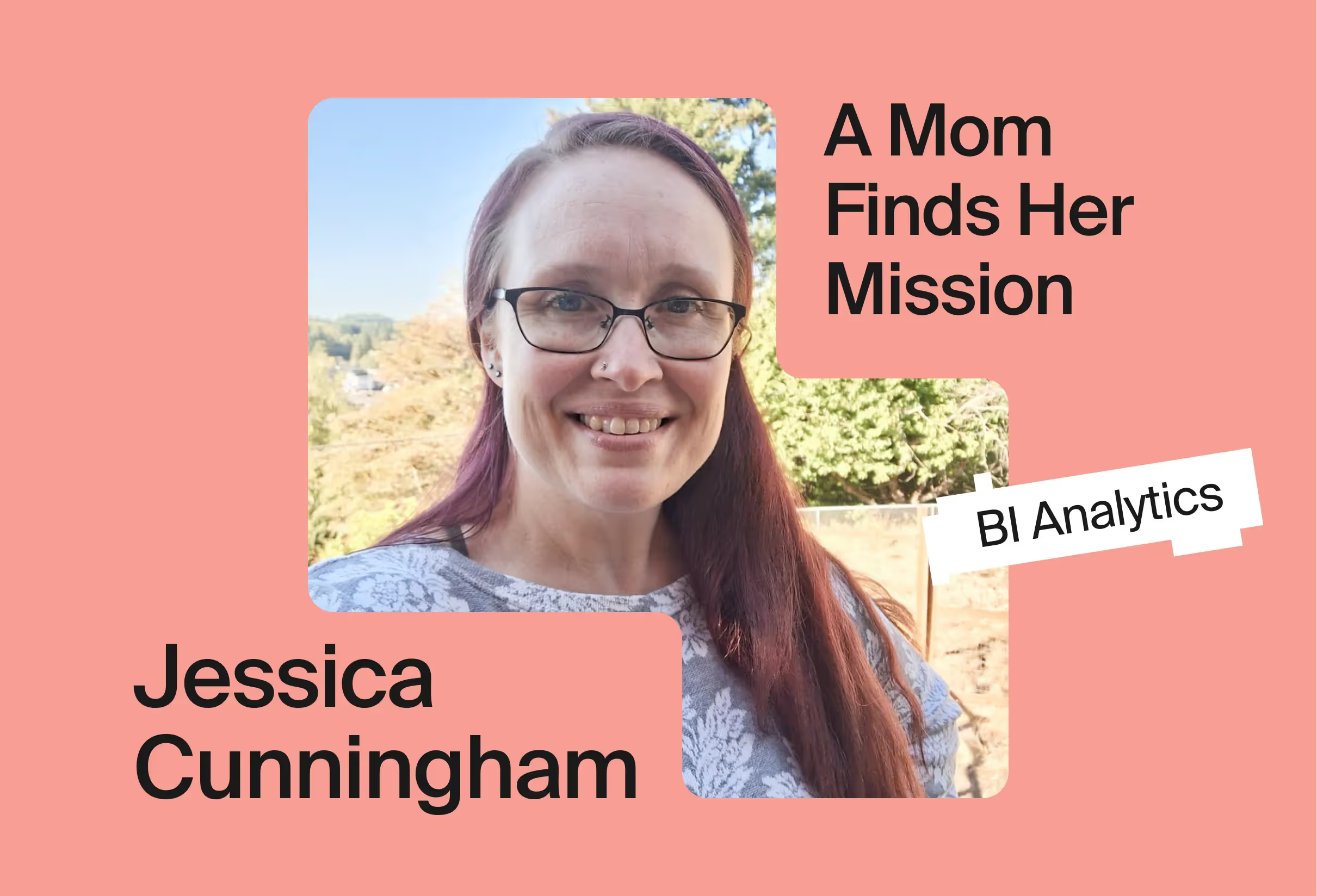


When we say that Jessica Cunningham pivoted to tech because of her family, what do you imagine? Most likely, the first thought is that she made the change to provide for her kids better. But there’s wiggle room in that chain of causality, too; it’s entirely possible that she switched because her family showed her that tech is a viable path. And there’s another interpretation: she took the plunge because, as the mother of school-age children, she knew the importance of education, and wanted to impact the learning experience.
Here’s the thing: all three are true. Often, when telling a story like this, a primary motivation wins out in service of a simple narrative. But very few people change their careers for just one reason, and if you’re switching to tech on multiple grounds, you, like Jessica, can also reap multiple rewards. Here’s how she did it.
More out there
Jessica initially went to college for a pre-law degree, but she herself admits, “I realized it wasn't the path for me at the time.” She instead got a degree in women’s studies, and from there, worked as a server, bartender, and restaurant manager before landing a job as a “scheduling ninja” at a virtual receptionist company. Not knowing it yet, this was her first taste of what it might be like to work in business intelligence analytics. Still, at this point she couldn’t fathom coherence out of her professional life; something wasn’t adding up.
I hadn't really landed in a solid career, so to speak. I definitely wasn't using my degree in any sense. Jessica Cunningham, TripleTen grad
Real life called, and in mid-2015, she became a stay-at-home mom who did occasional work as a notary public on the side. Just under 10 years later, she knew a pivot was necessary: “There were a lot of things personally within my family going on, and I had to make the decision to change. How things had been going wasn't working.”
But what should she do? Her eldest daughter had an associate’s degree in cyber security: “I was like, ‘Maybe tech is where I need to be, and I need to look more into roles that might fit and be of interest.’”
She initially thought of getting another degree, but that would take too long. Figuring there was something that’d get her into a new career faster, she started checking out bootcamps, but she wanted to be sure. “I needed a program that other people had been through. I knew I needed it to have legs underneath it,” she said. She had questions: “Am I going to be able to get a job at the end of this and be able to make an impact positively financially for my family?”
She found herself suspicious of many bootcamps, but when she had a conversation with a TripleTen rep, her worries were allayed. She felt she wasn’t just a number to the TripleTen advisor: “There was a very human element to it and that I think is what stood out to me the most.”
She enrolled.
Gaining skills (and a friendship)
During that conversation, although Jessica was initially considering another path, she was steered to the Business Intelligence Analytics (BIA) program based on her history. And it wasn’t just her professional history, either. Her experience as a mother played a role as well.
See, her kids have their own ways of learning, so according to her, “I have to often take information and traditional curriculum and switch it for their learning styles.” That sort of translation work set her up for BIA. “When you're looking in BIA, you're really taking in a lot of data that not everybody in the company or organization understands and then you're trying to answer their questions with their own data,” she said.
It was the right program for her both because of the subject matter and, she soon realized, because of the wide network of people who had her back. In fact, even with how much she knew after that conversation, she herself appreciatively admits, “I honestly thought that I was going to log in, have curriculum, and then maybe there might be some tutoring, but I didn't know how much support there was going to be.”
One form of support? Being paired with a fellow learner. “The first person I met, we hit it off really well and then we started studying late at night together and working through things,” she said.
My learning coach could not have chosen a better pair for me. Jessica Cunningham, TripleTen grad
They would help each other through tough sections, such as the one on SQL. When she needed more than the advice of a fellow student, she knew she could turn to the TripleTen experts to help her though. “I went to lots of tutoring sessions,” she said. “The expert tutors are fabulous.”
So as her time studying was winding down, she was ready to join an externship, an opportunity to tackle a hands-on tech project for a real-world company. Specifically, she helped analyze large language models for Supernova, a Canadian insurance firm.
I learned a lot. The mentors were fabulous. Jessica Cunningham, TripleTen grad
It was a taste of what it was like to work in tech, and it helped her and her fellow learners collaboratively sharpen their skills: “We were learning from each other and we were able to not just learn from each other but [also to] answer each other's questions, and being able to teach someone else something helps solidify what you already know.”
She had the skills down. It was time to land the job.
A career in doing good
Jessica hadn’t only been caring for her family and doing the bootcamp, though. She had even managed to find time to volunteer. “It's an education-based nonprofit, and I was on their research team. I was showing up to do something that I enjoyed, and that was a little bit of time every week when I could then practice some of the skills I was learning.”
This was in the background when she entered career acceleration at TripleTen, a phase all about improving interviewing skills as well as job-search assets like cover letters and resumes, something she really appreciated. “My resume was super outdated. I wasn't super familiar with how the AI tools would read it or even what places to put my resume to get feedback about how my resume should be formatted. It was seriously way outdated,” she said. “Without the career acceleration piece, I wouldn't have known how to put any of that together.”
She got that feedback. She updated her resume. She mastered the interview skills. But there was more to her meetings with her career coach. She also gained clarity on what path she wanted to take. “When I was setting up what I wanted to do, I kept coming back to wanting to be in the nonprofit world,” she said. “Using my skills for good or positive things in the world, that's what I wanted to do.”
And during one coaching conversation about her volunteering, Jessica was given an idea: “My career coach said, ‘You can build yourself a position in your organization.’ And I said, ‘There's no way. Nope.’”
She was at a nonprofit doing good already, but going for a paid gig there seemed unrealistic. A couple months later, the idea returned, and this time, she was more open to it.
With all of [the coaches’] uplifting conversations, positive feedback, with them helping me bridge my own understanding of the skills that I was showcasing and what I wanted, they were helping me open myself up to have those conversations with the people around me at the nonprofit. Jessica Cunningham, TripleTen grad
So she got more open about what she had been doing at TripleTen, and she kept applying the new skills she’d gained. The research chair noticed, and in the background, he started talking to the organization’s executive director. See, he was going to leave the role, and with Jessica’s new skills, he thought she’d be the right person to take the job. Finally, he talked to her about it: “He stepped back as the research chair and asked me if I wanted to do it, and I said sure. So that's when I started meeting with the executive director.”
I knew I couldn't say no. I knew that that's where I wanted to be. Jessica Cunningham, TripleTen grad
Everything was coming together: “I knew that the current projects I was working on were so important to me and that if I had a chance to be paid for them and could stop looking for other jobs, I wasn't going to turn it down.”
Now, she’s Director of IT and Research Operations at Defense of Democracy, a nonpartisan nonprofit aimed at making public education inclusive, and she’s crucial with the tech side of things, handling “everything from the very start: project plan, concept, what systems we are going to use, building those out all the way up through the training and development materials.”
.avif)
Even with her big title, she’s not stopping, either: “I'm capable of continuing to build the skills because TripleTen showed me I'm capable. And I showed myself that I'm capable of continuing to build those skills.” She’s still a mom, but there’s more to her identity now: “It feels like I have a purpose outside of my kids, which is huge.”
Most of all, she achieved something that initially felt completely unrealistic. “I am definitely in a role that wasn't even my dream when I started because I didn't even think it was possible,” she said. “I still sometimes pinch myself and say, ‘Am I really doing this work?’”



.avif)