





Key takeaways
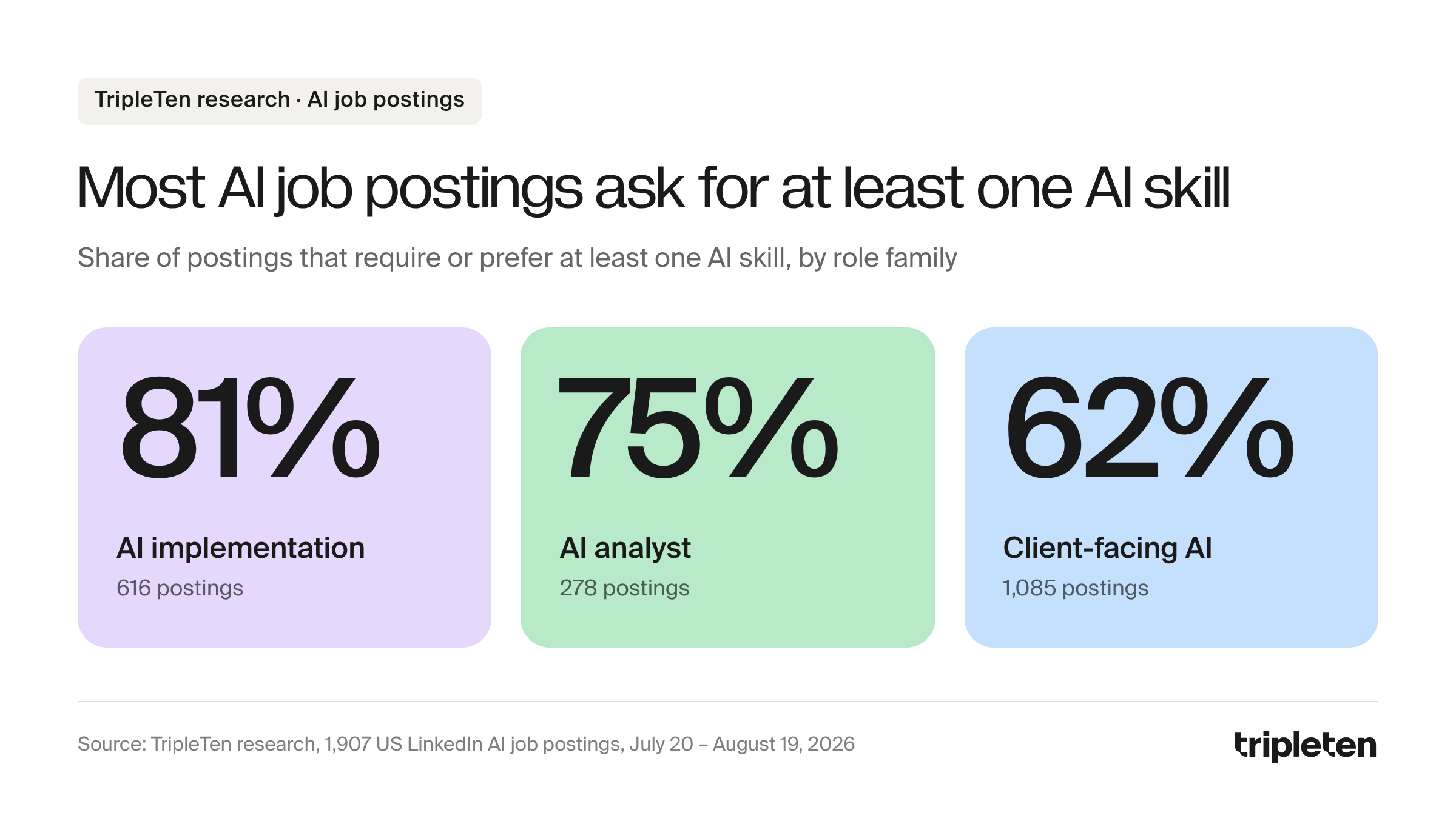
- At least one AI skill is asked for in 81% of AI implementation postings, 75% of AI analyst postings, and 62% of client-facing AI postings, according to TripleTen research on 1,907 US LinkedIn job postings.
- People and analysis skills still top the requirements: aligning departments and leadership leads AI implementation postings (60%), and data analysis leads AI analyst postings (69%).
- Preparing reports and searching for information make the requirements list in only 3–23% of postings. In the Anthropic Economic Index, these are the tasks AI most often completes on its own.
Employers hiring for AI roles want a short list of AI and data skills on top of the people skills AI doesn’t touch. Below, you’ll see which AI skills employers ask for in each role, which technical skills come with them, what stays human, and which skills barely make the requirements list anymore.
If you’re planning AI upskilling or a move into an AI role from operations, finance, HR, or customer work, use these AI job requirements as a map of what you already bring and what to add.
Methodology: how we read AI job postings
We read every posting in full and counted a skill only when the posting asked for it in so many words. Here’s the setup:
- Source: 1,907 unique LinkedIn job postings in the US, published July 20–August 19, 2026.
- Roles: three families of AI roles that experienced professionals move into.
- AI implementation (616 postings): AI enablement, adoption, transformation, and AI operations roles.
- AI analyst (278): business and data analyst roles that work with AI.
- Client-facing AI (1,085): solutions engineers, AI consultants, and customer-side implementation role.
- Note: 72 postings fit two families and count in both.
- Method: an AI reading agent went through each posting and marked every skill as required, preferred, or listed in duties only, with a verbatim quote. A script matched all 24,671 quotes against the posting text, and the 2 that didn’t match were dropped. In this article, “asks for” means required or preferred.
- Context: we mapped each skill to task data from O*NET, the US Department of Labor’s occupation database, and to the Anthropic Economic Index, which shows how often AI does a task on its own versus helping a person with it.
TripleTen is a professional education platform with AI-focused programs for people switching careers and for tech professionals, and we track postings like these to keep our programs in line with what employers ask for.
A few limits to keep in mind: the sample covers one month and one job board, and the Anthropic data covers Claude usage only.
Which AI skills do AI jobs require?
Understanding how AI works and using AI tools lead the list, and most postings ask for at least one AI skill: 81% in AI implementation, 75% in AI analyst, and 62% in client-facing AI roles.

Three things stand out in these AI job requirements:
- Prompting ranks lower than you might expect. Writing prompts shows up in 15–24% of postings, well below using AI tools or understanding how models work. This suggests employers fold prompting into using the tools and rarely hire for it as a separate skill.
- AI rules matter most in implementation roles. Setting rules for AI use appears in 26% of AI implementation postings, more than twice as often as in AI analyst (10%) or client-facing AI postings (8%).
- Some AI work comes with the job. Finding where AI saves time appears as a duty in 30% of all postings, and driving AI adoption across teams in 24%, usually without a request for prior experience. Employers expect the new hire to do this work, and they don’t expect a track record of it yet.
Ability to break down business processes into steps, identify where AI solutions may help, and build practical workflows with appropriate guardrails. — AI Enablement Specialist, Allspring Global Investments
The technical skills behind AI roles
Each AI role comes with its own technical stack: process automation for implementation roles, SQL and BI tools for analysts, and code and APIs for client-facing roles.
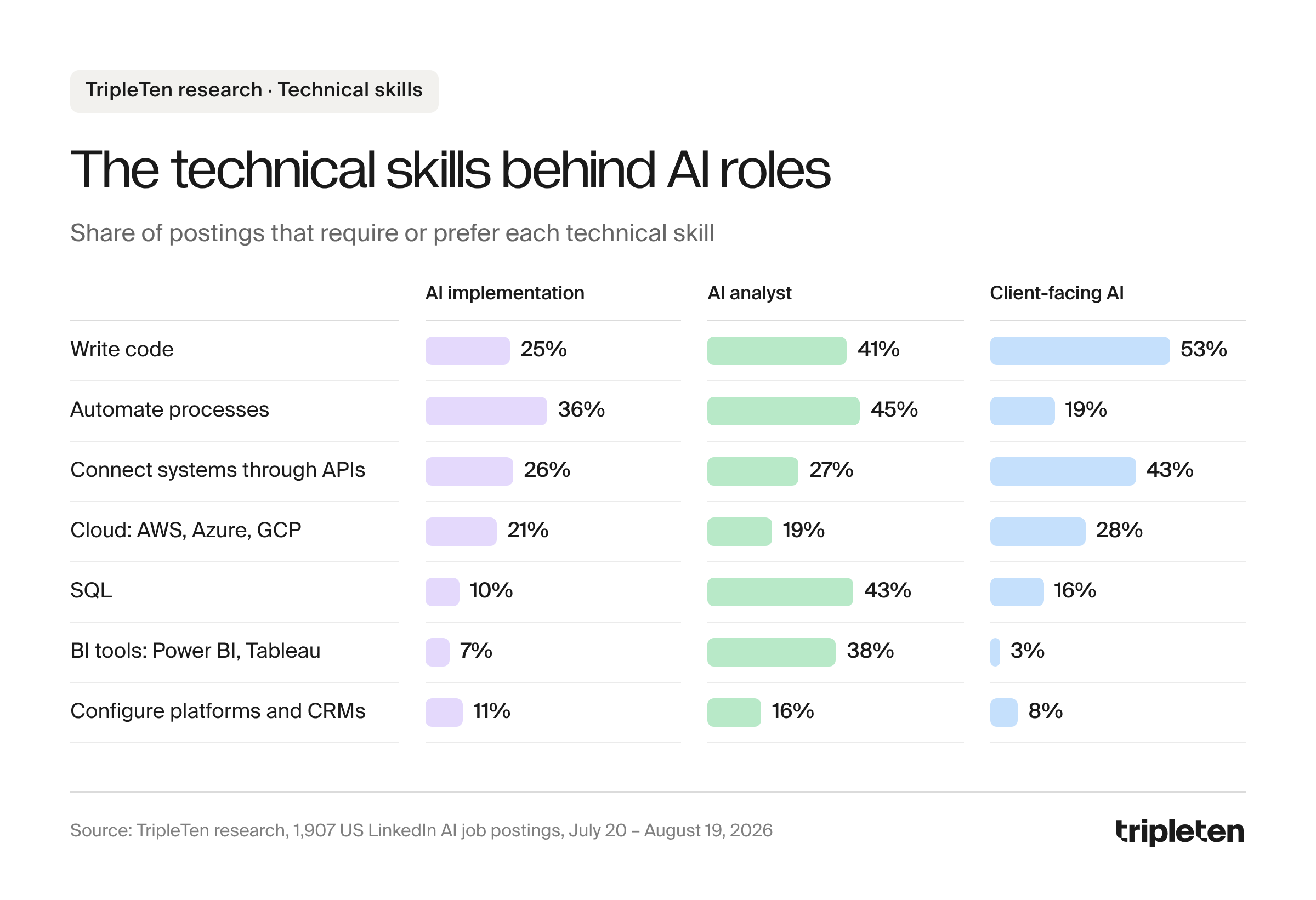
If you’re moving from operations or HR into AI implementation, automation (36%) matters more than code (25%). If you’re aiming at AI analyst roles, expect SQL (43%) and BI tools (38%) in about two in five postings. Client-facing AI roles are the most technical of the three, with code in 53% of postings and APIs in 43%.
5-7+ years in data analytics, BI/dashboard development, or reporting automation, ideally with procurement or finance data. — Data Analytics, Reporting & AI Automation Analyst, Cypress HCM
Human skills still lead the requirements
The most requested skill in AI implementation postings is aligning departments and leadership, in 60% of postings. In every role family, people and analysis skills lead the list.

The task data explains why. In O*NET and the Anthropic Economic Index, AI touches only 28% of the tasks behind aligning departments and leadership. For explaining and advising, AI touches 76% of tasks but does the work on its own in fewer than half of cases (47%). Most of the time, it helps the person doing it.
Strong communication, documentation, training, storytelling, and collaboration skills, with the ability to bring skeptical teams along. — Director, AI Transformation Architect, Ford Motor Company
People management is rarely required: it appears in 17% of AI implementation postings and in only 2% of AI analyst and client-facing AI postings.
Skills employers rarely hire for anymore
Preparing reports and searching for information make the requirements list in only 3–23% of postings, even though many postings still list them as duties. In the Anthropic Economic Index, these are the tasks AI most often completes on its own.

That share is growing fast. On the reporting tasks tracked across every release of the Anthropic Economic Index, the share AI did on its own grew from 61% to 77% between November 2025 and May 2026.
This is the AI skills gap in practice for experienced professionals. If reports are the core of your current job, build on them: the analysis, recommendations, and process changes that come out of those reports are the skills the postings ask for.
Which AI role fits your experience?
Your current experience already covers the top of one of these lists. Match it to the role family, then add the AI and technical skills that role asks for.
If your background matches the first row, TripleTen’s AI Transformation Management program is built around those skills: finding the manual steps in a process, rebuilding them with AI, getting the team to use the new tools, and measuring the result. It runs part-time alongside a full-time job, and you finish with a portfolio of projects to show employers or your current manager.
If your background matches the second row, the AI Business Analytics program adds SQL, BI, and automation to the analysis experience you already have, on the same part-time schedule and with the same project portfolio.
If your background matches the third row, the AI Automation program is the closest fit. You’ll build AI agents and automations that connect business tools through APIs, two of the most common technical asks in client-facing AI postings (APIs in 43%, agents in 25%). It also runs part-time and ends with a project portfolio you can walk clients and interviewers through.