QA Engineering Program
Join our 5-month part-time QA Program and gain the skills— including AI testing tools—for remote-friendly roles with a $62,000 median starting salary.


Online job training and support designed for your real life
salary increase
background needed
2.5k+ reviews
*Get a relevant job in 10 months or your tuition back when you complete our included Career Services package and make a good-faith effort to find a job. Details in our Terms of Use.
What is QA Engineering?
QA Engineers break software and document the results. They test software to catch bugs, and work with software engineers to fix them. QA combines analytical thinking with attention to detail.
As AI-generated code grows, demand for skilled QA specialists is not going down—but evolving. QA is one of the most accessible entry points into tech, with a program offering the necessary training in just a few months without requiring a computer science degree.

Where can your QA training take you?
QA is a high-income career track with high potential for growth
You after TripleTen




How you’ll get a new career in 5 months:
Our grads get great jobs with both startups and industry giants
insights
Testing Fundamentals
This sprint explores the role of a Software Tester and how they fit into the Software Development Life Cycle (SDLC). It also takes a detailed look at the different types of testing before introducing you to exploratory testing. You’ll then finish the sprint by completing your very first testing project!
Test Design and Documentation
This sprint covers the analysis and decomposition of product requirements while identifying gray areas. It then looks at writing reports on test results, finding errors in web services, and understanding their structure. You'll use various techniques to design and optimize your tests before putting your knowledge to use in your second project by creating your own test documentation.
Testing Web Applications
This module covers the basics of web application structure, including client-server architecture, front-end, back-end, URL, and HTTP. You'll compile a checklist of tests for the interface elements and learn how to work with industry tools such as Figma, DevTools, and Charles. At the end of the module, you will test a new routing interface.
APIs
This sprint covers how to test APIs using Postman. You’ll learn everything you need in order to understand APIs, such as REST architecture, JSON, and the HTTP request and response structure. As usual, there will be a project at the end.
Understanding Databases
This sprint is all about databases. You’ll study the console while learning how to work with tables and write SQL queries.
Testing Mobile Applications
This sprint is all about mobile applications. Here you’ll learn how to use the Android Studio emulator, practice setting logs, and become familiar with the intricacies of testing on a real device.
Python
This sprint introduces you to one of the most important programming languages in the world: Python. You’ll learn the basics of the language and how to apply it to testing.
Browser Automation
This sprint teaches you how to use Python to automate a web browser. You’ll build on the previous chapter and learn about a commonly-used testing tool called Selenium.
Applied Testing: Final project
The final project gives you the chance to put all of your learning into practice as you test a mobile app, a web app, and an API. You’ll design and perform tests, then submit bug reports with your findings.
Lifetime access to
all program updates

or pre-requisites.
with regular project
deadlines.
Stuck? Instructors and our
AI assistant are here to help
Get instant hints from Dot, our friendly AI assistant, or connect with an instructor who works in the field you’re entering.

All-in-one flexible learning experience
Learn concepts, practice testing tasks, work on projects, schedule 1-on-1 tutoring, and get feedback all in one place!

Gain real work experience.
How do you find a job when everything requires experience?
Through TripleTen’s externships! Students can apply to take on real business projects for client companies to put on their resumes
and in their portfolios.


Get hired for a career-track role with our help
Our QA program teaches you more than testing—you'll master the job search, too. You'll get personalized coaching to position your background for QA roles, optimize your resume and LinkedIn, learn proven networking strategies, and practice mock interviews with industry professionals.

Will I get a certificate?
Of course! It’ll look great on your resume and LinkedIn :-)

2,600+ TripleTen alumni. 80% from a non-STEM background!

“Learning something new can be stressful, but it was probably one of the least stressful learning experiences I've ever had.”

“The instructors touched me and gave me encouragement when I felt a lack thereof. When I couldn't learn something fast enough and I didn't understand and I was kind of scared, they asked questions to pull it out of me.”

“The instructors were amazing, way better than any tutor that I ever had in college or even the academy.”

“It just felt like it was the career that I had been
searching for for many years and I finally was able to
put a name on it.”

“When I was doing projects, I found that I liked to break software and provide feedback. So basically, when I learned that doing that could be a job, I was all about it.”

“Their curriculum is thoughtfully designed, blending theory with hands-on projects that prepare you for real-world scenarios. The instructors are knowledgeable and incredibly supportive, always ready to guide you through challenges.”

“Something that I learned in the externship is a direct reason why I have the job that I have now.”
“Learning something new can be stressful, but it was probably one of the least stressful learning experiences I've ever had.”
“The instructors touched me and gave me encouragement when I felt a lack thereof. When I couldn't learn something fast enough and I didn't understand and I was kind of scared, they asked questions to pull it out of me.”
“The instructors were amazing, way better than any tutor that I ever had in college or even the academy.”
“It just felt like it was the career that I had been
searching for for many years and I finally was able to
put a name on it.”
“When I was doing projects, I found that I liked to break software and provide feedback. So basically, when I learned that doing that could be a job, I was all about it.”
“Their curriculum is thoughtfully designed, blending theory with hands-on projects that prepare you for real-world scenarios. The instructors are knowledgeable and incredibly supportive, always ready to guide you through challenges.”
“Something that I learned in the externship is a direct reason why I have the job that I have now.”
“Learning something new can be stressful, but it was probably one of the least stressful learning experiences I've ever had.”
“The instructors touched me and gave me encouragement when I felt a lack thereof. When I couldn't learn something fast enough and I didn't understand and I was kind of scared, they asked questions to pull it out of me.”
“The instructors were amazing, way better than any tutor that I ever had in college or even the academy.”
“It just felt like it was the career that I had been
searching for for many years and I finally was able to
put a name on it.”
“When I was doing projects, I found that I liked to break software and provide feedback. So basically, when I learned that doing that could be a job, I was all about it.”
“Their curriculum is thoughtfully designed, blending theory with hands-on projects that prepare you for real-world scenarios. The instructors are knowledgeable and incredibly supportive, always ready to guide you through challenges.”
“Something that I learned in the externship is a direct reason why I have the job that I have now.”
4.8/5 across 2,500+ reviews on trusted platforms



A Top 3 Online Program
Featured in




We believe that you’ll get into tech in 10 months. In fact, we put money on it.
career coach
The TripleTen money-back
guarantee is legally binding.
For details, please see
our Terms of use
We also have
a fair refund policy
After starting any program, you have 2 weeks to withdraw with a 100% refund. Check our Terms of Use for more info.
FAQ
Complete FAQWhat is a QA Program?
What is a QA Program?
TripleTen's QA Program is an accelerated, online training program that teaches beginners the skills needed to work as a Quality Assurance engineer.
Unlike a traditional college degree, TripleTen's QA Program focuses exclusively on job-ready skills — covering the software testing methods, tools, and workflows used by real engineering teams.
Is QA harder than coding?
Is QA harder than coding?
QA engineering is generally considered more accessible than software development for beginners. While both roles require analytical thinking and attention to detail, QA testing does not require the same depth of programming knowledge as coding, making it one of the most beginner-friendly entry points into the tech industry.
Can I become a QA tester without learning programming?
Can I become a QA tester without learning programming?
Yes. It is entirely possible to start a QA career without a programming background.
Manual QA is an excellent entry into tech that does not require advanced programming skills. You’ll learn only the essential Python needed to understand automation concepts, test logic, and tooling—no heavy coding required.
Do I need a background in math or computer science to enroll in TripleTen's QA Program?
Do I need a background in math or computer science to enroll in TripleTen's QA Program?
No. TripleTen's QA Program requires no prior background in math, computer science, or software testing.
The program is specifically designed for complete beginners and career changers entering tech roles for the first time.
How long does TripleTen's QA Program take to complete?
How long does TripleTen's QA Program take to complete?
TripleTen's QA Program takes 5 months to complete, with an expected study commitment of approximately 20 hours per week.
The program has flexible learning schedules and a fully remote format, making it possible for working professionals and career changers to complete the curriculum without leaving their current jobs.
Will I get a job after graduating from TripleTen's QA Program?
Will I get a job after graduating from TripleTen's QA Program?
TripleTen's QA Program graduates have strong job prospects. 80% of TripleTen graduates who land tech jobs come from non-tech backgrounds — demonstrating that a career change into QA engineering is not only possible but common for program completers.
What happens if I don't get a job after completing TripleTen's QA program?
What happens if I don't get a job after completing TripleTen's QA program?
TripleTen offers a full tuition refund guarantee for graduates who do not land a tech job within 10 months of completing the QA program. If the job search is unsuccessful within that window, students receive 100% of their tuition back.
Tuition Refund Eligibility Requirements
To qualify for TripleTen's money-back job guarantee, graduates must meet all of the following conditions:
- Complete the full program, including the Career Prep and Career Acceleration modules
- Actively pursue the job search, applying to relevant QA positions and participating in interviews
- Maintain regular contact with an assigned TripleTen career coach throughout the job search
- Be a U.S. resident at the time of graduation and during the job search period
You can find more details in our Terms of Use.
What career services does TripleTen offer QA graduates?
What career services does TripleTen offer QA graduates?
TripleTen provides comprehensive career support before, during, and after the job search.
Job search prep during the program
Students graduate with the tools and materials needed to compete in the tech job market, including:
- Resume and cover letter writing — crafting compelling application materials tailored to QA roles
- Project portfolio — a portfolio of real-world QA projects that demonstrates hands-on experience to employers
- GitHub portfolio — a professional profile showcasing technical work and test artifacts
- Interview coaching — preparation for both technical QA interviews and behavioral interviews
- Soft skills training — building workplace communication and confidence for a new tech role
- Job digest — a curated feed of relevant QA job openings sent directly to students
Post-graduation career support
TripleTen's career services do not end at graduation. Alumni receive ongoing support that includes:
- Up to three career coaching sessions per year, available whenever needed
- Career materials review — resume, cover letter, and portfolio updates for new job searches
- Free career assessment tools to evaluate current skills and identify areas for growth
- Continued career advice for graduates who transition into a new role or return to the job market
This long-term support model is designed to help TripleTen graduates succeed not just in landing their first tech job but throughout their careers in the industry.
How does the learning process work in TripleTen's QA program?
How does the learning process work in TripleTen's QA program?
TripleTen's Quality Assurance (QA) program is a fully online, flexible program designed for beginners with no prior QA experience. Students learn through a structured, multi-modal approach that includes:
- Hands-on practice inside the TripleTen interactive learning platform
- Instructor-led video lessons that guide learners through core QA concepts and tools
- AI-powered support via Dot, TripleTen's built-in AI assistant, available on demand
- Personalized feedback from expert human reviewers on real project work
The program offers flexible, online learning schedules, with project deadlines every two weeks to keep you on track. By the end, students have practical QA testing experience they can apply to entry-level roles.
What will I learn in TripleTen's QA course?
What will I learn in TripleTen's QA course?
TripleTen's QA course teaches students to test real-world applications across multiple platforms. Learners practice on four actual applications built by TripleTen's engineering team, covering mobile, backend, desktop, and cross-platform environments.
Students gain hands-on experience in seven core QA disciplines:
- Manual testing — systematically verifying software behaves as expected
- Exploratory testing — identifying bugs through unscripted, investigative testing
- UI testing — validating user interface elements and functionality
- API testing — testing application programming interfaces for reliability and performance
- Mobile testing — evaluating apps on mobile devices and environments
- AI-assisted test design — using artificial intelligence tools to plan and improve test coverage
- Test automation fundamentals — introduction to automating repetitive testing tasks
How is the curriculum structured?
How is the curriculum structured?
Each sprint (set of lessons) includes step-by-step instructions, real-life examples, interactive spreadsheets, and built-in AI support. This format makes advanced QA topics — including APIs, debugging, and automation — approachable for complete beginners.
By the end of the program, students have tested four real applications and built a portfolio of practical QA work ready for entry-level job applications.
What makes TripleTen’s QA Program one of the best?
What makes TripleTen’s QA Program one of the best?
TripleTen's QA Program stands out for its combination of real-world project experience, personalized support, flexible structure, and a money-back guarantee — making it one of the most outcome-focused QA training programs available online.
TripleTen is at the forefront of AI-ready career preparation: in the QA program, you'll master AI literacy, AI-assisted test design, and AI-powered automation—skills that set you apart in today's job market.
Is a QA program worth it?
Is a QA program worth it?
For most career changers and beginners looking to break into tech, a QA program is worth it. It offers a faster, more affordable, and more practical path to a QA engineering career than a traditional four-year degree — with the average QA engineer in the U.S. earning between $60,000 and $90,000 per year at the entry level.
What is the career growth path for a QA Engineer?
What is the career growth path for a QA Engineer?
QA engineering offers a clear and well-defined career progression. Most professionals begin in entry-level manual testing roles and advance into specialized, senior, or leadership positions as they gain experience with tools, automation, and software development workflows.
Entry-level QA roles
Graduates of TripleTen's QA Program typically enter the workforce in one of the following roles:
- QA Tester / QA Analyst — executing test cases, reporting bugs, and validating software functionality
- QA Engineer — designing and implementing test plans across web, mobile, and API environments
- Quality Control Engineer — ensuring products meet defined quality standards before release
- QA Specialist / QA Coordinator — supporting testing processes and coordinating quality workflows across teams
Mid-level QA roles
With one to three years of experience, QA professionals commonly advance into:
- QA Automation Engineer — writing and maintaining automated test scripts using tools like Selenium and Python
- Test Engineer — designing comprehensive testing strategies across complex software systems
- SDET (Software Development Engineer in Test) — a hybrid role combining software development skills with QA expertise
Senior and leadership QA roles
Experienced QA engineers can progress into:
- Senior QA Engineer — leading test strategy, mentoring junior testers, and owning quality across product lines
- QA Lead / QA Manager — managing QA teams, defining processes, and reporting on quality metrics to stakeholders
- Director of Quality Assurance — overseeing organizational quality strategy at a department or company level
How much does the QA program cost and what are the payment options?
How much does the QA program cost and what are the payment options?
Tuition cost depends on the payment option. The most affordable is the upfront payment, starting at $5,950. Flexible payment options are available too.
We offer three payment options:
1. Upfront before you start.
2. Monthly installments while you study.
3. Learn now, pay later options.
No enrollment fee. Other repayment options and financing partners available.
What can TripleTen graduates expect from their first QA job?
What can TripleTen graduates expect from their first QA job?
Most TripleTen QA Program graduates enter the workforce in entry-level QA Engineer or QA Tester roles. These positions primarily focus on manual testing and provide a strong foundation for long-term career growth in software quality assurance.
Common responsibilities in an entry-level QA role:
- Execute test cases — testing UI, APIs, and mobile applications against defined requirements
- Conduct exploratory testing — investigating software behavior to uncover unexpected bugs
- Analyze requirements — reviewing product specifications to understand expected functionality
- Find and report bugs — documenting defects clearly and accurately for development teams
- Collaborate with developers and product teams — communicating testing results and advocating for quality throughout the development cycle
Junior QA engineers typically work with industry-standard tools including:
- Jira — bug tracking and project management
- Postman — API testing
- SQL — querying databases to verify data integrity
- JSON/XML — working with data formats in API and backend testing
- DevTools — inspecting and debugging web applications
- Selenium — browser-based test automation
- AI-assisted workflows — using artificial intelligence to support test design and coverage
Will TripleTen’s program give me the experience I need?
Will TripleTen’s program give me the experience I need?
Yes. TripleTen's QA Program is built around hands-on, practical experience — not theory.
You’ll learn to test apps end-to-end, use QA tools like Postman, Jira, Selenium, DevTools, and practice QA workflows used in real tech teams. You won’t just learn theory — you’ll gain hands-on experience testing real applications.
You’ll complete:
- 9 technical sprints
- 6 portfolio projects
- API testing
- Mobile testing
- UI testing
- Automation foundations
- Full bug reports + requirements analysis
Will I get a certificate after completing the program?
Will I get a certificate after completing the program?
Yes. After completing all the sprints and final projects, you will receive a TripleTen QA certificate. This certificate signals to employers that you’ve built job-ready skills, completed practice projects, and tested real-world applications.
Why do QA Engineers need to learn AI skills today?
Why do QA Engineers need to learn AI skills today?
QA engineers do not need to become AI experts, but knowing how to use AI productivity tools in software testing has become a significant competitive advantage in today's job market. Hiring managers increasingly look for QA candidates who can work alongside AI tools, making AI literacy an essential skill for anyone entering the field now.
TripleTen's QA Program teaches practical, job-relevant AI skills, including:
- Safe and responsible AI use — understanding the limitations and risks of AI tools in a professional testing environment
- AI-assisted test scenario generation — using AI to create more thorough and effective test cases faster
- Faster test analysis and automation — leveraging AI tools to speed up repetitive testing tasks and improve coverage
- Understanding AI's impact on QA — knowing how AI is changing the role of QA engineers and how to adapt
How is AI used in TripleTen's QA Program?
How is AI used in TripleTen's QA Program?
AI is integrated throughout TripleTen's QA Program — not as an add-on, but as a core part of how students learn and work. The program is designed to mirror how modern QA engineers use AI tools on the job, so graduates enter the workforce already comfortable with AI-assisted workflows.
TripleTen students apply AI tools across six key areas of QA practice:
- Test design — using AI to generate and refine test cases for more thorough coverage
- Bug analysis — leveraging AI to identify patterns in defects and prioritize issues effectively
- Test automation support — using AI assistance to write and improve automated test scripts
- Debugging — applying AI tools to investigate and resolve software failures faster
- Improving test coverage — using AI to identify gaps in testing and strengthen overall quality assurance
- Project reviews — AI provides feedback on student project submissions before human expert reviewers do, giving students faster, iterative improvement cycles
TripleTen's proprietary AI assistant, Dot, is available to students throughout the program. Dot provides on-demand support for technical questions, concept clarification, and learning guidance — so students are never stuck waiting for help.
Will AI replace QA testers?
Will AI replace QA testers?
No. AI will not replace QA testers — it is making skilled QA engineers more valuable, not redundant. While AI can generate code and automate certain repetitive tasks, it cannot reliably perform the critical judgment-based work that defines quality assurance.
Learning that fits your life, with constructive feedback and top-notch support.


Practice and improve your skills with personal feedback from your instructors
Learn QA Engineering the way you’d learn on the job—with detailed feedback and help from experienced QA Engineers.
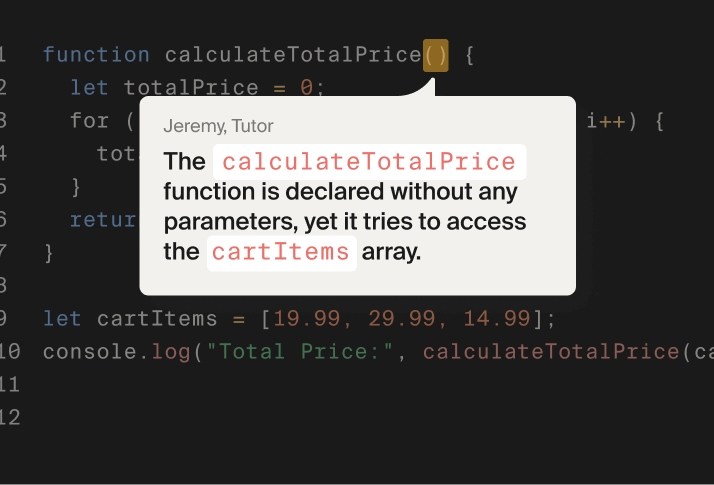
Reach out to your learning coach to talk through any issues you encounter. They’ll keep you motivated and help problem-solve.

You’re never alone—our instructors always have your back

Get real work experience: complete a QA Engineering project for one of our 250+ employer partners
Through your TripleTen program, you’ll connect with a business client and use your new skills to build a real-world project to put on your resume.
Meet with the client company rep to receive live feedback.
and LinkedIn

“I liked that there real projects with real companies at TripleTen, and that you had to finish projects in a certain amount of time.”
Become a magnet for recruiters with a personal career coach and AI job-hunting tools

Get help and make progress whenever you study—whether at breakfast or 2am






unique with Dot—it adapts to
my learning style like a real
mentor.

instead of giving answers—
that’s how you really learn.

what I'm going to name my
next child...