




Breaking into cybersecurity isn't a single leap — it's a series of deliberate steps. Whether you're pivoting from IT support, teaching, or a completely non-technical field, understanding the realistic cybersecurity career path helps you set achievable goals and sidestep the mistakes that slow most people down.
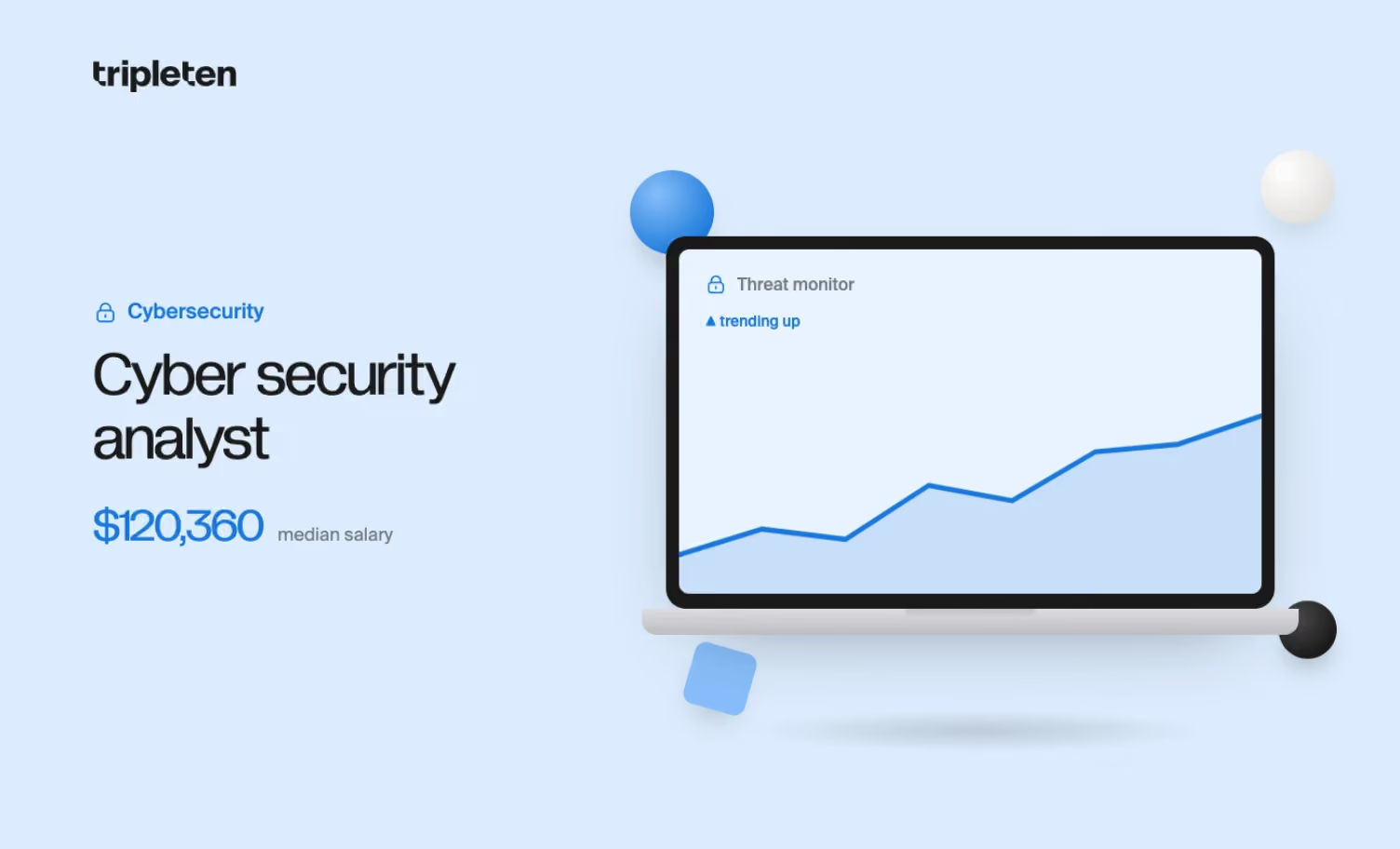
The demand is real. The U.S. Bureau of Labor Statistics projects 28.5% employment growth for Information Security Analysts from 2024 to 2034 — far faster than the average for all occupations. The median annual wage hit $124,910 in May 2024, more than double the national median for all workers.
This guide maps the most common cybersecurity career paths, explains what each stage actually requires, and gives you a realistic sense of how long it takes to move from entry-level to leadership. You'll also find the alternative tracks — GRC, cloud security, penetration testing, and incident response — along with guidance on choosing the one that fits your strengths.
What cybersecurity career paths actually look like
Cybersecurity is a career lattice, not a single ladder. Most people don't land a "cybersecurity analyst" role on day one. They come in through feeder roles — help desk, IT support, systems administration, even compliance and audit — and transition into security-focused positions once they've built a foundation.
The most common progression follows this core ladder:
- SOC Analyst / Security Operations (0–2 years)
- Security Analyst (2–5 years)
- Security Engineer (5–8 years)
- Security Architect or Security Manager (8–12 years)
- Director of Security or CISO (12+ years)
Alongside that core path, several alternative tracks branch off:
- GRC (Governance, Risk, and Compliance). Policy writing, risk assessments, vendor reviews, and frameworks like NIST and ISO 27001.
- Cloud Security. IAM, posture management, and workload protection across AWS, Azure, and Google Cloud.
- Penetration Testing / Offensive Security. Ethical hacking, vulnerability exploitation, and security assessments.
- Incident Response / Blue Team. Threat hunting, forensics, containment, and recovery.
Each track has its own skill requirements, certifications, and salary trajectory. The key is picking a path that fits how you think — whether you'd rather build defenses, hunt threats, or shape policy.
Entry points: how to get into cybersecurity
With a degree
The BLS lists a bachelor's degree as the typical entry-level education for Information Security Analysts, paired with less than five years of work experience. A degree in cybersecurity, computer science, IT, or a related field builds a solid foundation in networking, operating systems, and security principles.
The degree alone won't get you hired, though. Employers also want:
- Hands-on projects — a home lab, open-source security contributions, or real-world simulations.
- Certifications — Security+ is the most common entry-level credential.
- IT fundamentals — working knowledge of Windows, Linux, networking, and IAM basics.
Without a degree
You can absolutely break into cybersecurity without a four-year degree — you'll just need to prove competence other ways:
- Certifications. Security+, SSCP (Systems Security Certified Practitioner), or vendor-specific credentials like Microsoft Security Operations Analyst.
- Bootcamps. Structured programs that build skills through hands-on labs and real projects.
- Feeder roles. Start in help desk, IT support, or junior systems administration to develop the foundation.
- Portfolio. Document your home lab work, capture-the-flag (CTF) challenges, and security assessments on GitHub.
The biggest mistake career changers make is stacking certifications without showing they can actually apply the knowledge. Employers want people who can triage alerts, analyze logs, and troubleshoot security tools — not just ace an exam.
For a step-by-step breakdown of how to enter the field, see our cybersecurity career guide.
The core cybersecurity career ladder
What each stage of the traditional career path looks like — responsibilities, required skills, certifications, and salary benchmarks.
Stage 1: SOC Analyst / Security Operations (0–2 years)
What you do: Monitor security alerts in a Security Operations Center (SOC), triage incidents, analyze phishing emails, escalate threats, and document findings. This is the front line — where you learn to separate real threats from false positives.
Skills you need:
- Networking fundamentals (TCP/IP, DNS, firewalls)
- Windows and Linux OS basics
- Log analysis and SIEM (Security Information and Event Management) tools
- IAM (Identity and Access Management) basics
- Incident workflow and ticketing systems
Tools you'll use: Splunk, Microsoft Sentinel, CrowdStrike, Palo Alto Networks firewalls, vulnerability scanners.
Certifications: Security+, SSCP.
Signal you're ready to advance: You're writing better detection rules, cutting down false positives, handling incidents on your own, and understanding the why behind alerts — not just the what.
.avif)
Stage 2: Security Analyst (2–5 years)
What you do: Run incident response, conduct threat hunting, manage vulnerabilities, and validate controls. You own investigations end to end and deliver concrete remediation recommendations.
Skills you need:
- Scripting (Python, PowerShell, Bash)
- Forensics basics (memory, disk, network analysis)
- MITRE ATT&CK framework
- Advanced log analysis and correlation
- Risk assessment and prioritization
Certifications: CySA+ (Cybersecurity Analyst), GCIH (GIAC Certified Incident Handler), CEH (Certified Ethical Hacker).
Salary benchmark: BLS median annual wage of $124,910 for Information Security Analysts (May 2024).
Signal you're ready to advance: You're designing and implementing security controls, automating repetitive tasks, mentoring junior analysts, and taking on strategic projects beyond daily ops.
Stage 3: Security Engineer (5–8 years)
What you do: Build and maintain security infrastructure — firewalls, IAM systems, endpoint protection, cloud security controls, and detection pipelines. You're not just responding to threats anymore; you're engineering the systems that stop them.
Skills you need:
- Cloud platforms (AWS, Azure, Google Cloud) and their native security services
- Infrastructure as code (Terraform, CloudFormation)
- IAM architecture and zero-trust principles
- Network segmentation and micro-segmentation
- Detection engineering and SOAR (Security Orchestration, Automation, and Response)
Certifications: CISSP (Certified Information Systems Security Professional), AWS Certified Security – Specialty, Azure Security Engineer (AZ-500), CCSP (Certified Cloud Security Professional).
Salary benchmark: Security engineers average $159,454 annually, per Glassdoor (December 2025).
For a detailed look at this role specifically, see our guide on how to become a cybersecurity engineer.
Stage 4: Security Architect or Security Manager (8–12 years)
At this level, you pick a lane: technical track (architect) or leadership track (manager).
Security Architect. Design enterprise security programs, zero-trust architectures, identity frameworks, and segmentation strategies. You set the technical vision and make sure it lines up with business goals.
- Skills: Enterprise architecture, risk modeling, compliance frameworks, vendor evaluation, advanced cloud and IAM design.
- Certifications: CISSP, CCSP, Microsoft Cybersecurity Architect (SC-100).
- Salary benchmark: Security architects average $149,773 annually (Payscale, 2026).
Security Manager. Lead a security team, manage hiring and priorities, communicate with stakeholders, and translate technical risks into terms the business can act on. You own the team's performance and roadmap.
- Skills: People management, budgeting, stakeholder communication, strategic planning, risk communication.
- Certifications: CISSP, CISM (Certified Information Security Manager).
- Salary benchmark: Information security managers average $189,516 annually (Glassdoor, May 2026).
Stage 5: Director of Security or CISO (12+ years)
What you do: Own organization-wide security strategy, compliance, executive leadership during incidents, board reporting, and budget allocation. You're the face of security to the C-suite and external regulators.
Skills you need: Risk governance, executive communication, regulatory knowledge (SEC cyber disclosure rules, PCI DSS v4.0.1), vendor and insurance negotiations, crisis management.
Salary benchmark: Chief Information Security Officers (CISOs) earn a median annual salary often cited at $321,000 (Glassdoor-based data, April 2026).
Alternative cybersecurity career paths
Not everyone follows the SOC-to-CISO route. Four high-demand security tracks branch off early and lead somewhere distinct.
GRC (Governance, Risk, and Compliance)
What you do: Write policies, run risk assessments, manage vendor security reviews, and maintain compliance with frameworks like NIST, ISO 27001, SOC 2, and HIPAA.
Best for: People who gravitate toward documentation, process design, and stakeholder communication over hands-on technical work.
Certifications: CISA (Certified Information Systems Auditor), CRISC (Certified in Risk and Information Systems Control), CISSP.
Entry point: Compliance analyst, IT auditor, or junior GRC analyst.
Cloud Security
What you do: Secure cloud workloads, design IAM policies, monitor security posture, and implement workload protection across AWS, Azure, and Google Cloud.
Best for: Engineers who want to plant their flag in the fastest-growing area of cybersecurity.
Certifications: AWS Certified Security – Specialty, Azure Security Engineer (AZ-500), CCSP.
Entry point: Cloud engineer, DevOps engineer, or security analyst with cloud exposure.
Penetration Testing / Offensive Security
What you do: Simulate attacks to find vulnerabilities, run red-team exercises, and deliver detailed remediation reports that actually get fixed.
Best for: People who enjoy problem-solving, reverse engineering, and ethical hacking.
Certifications: CEH, OSCP (Offensive Security Certified Professional), GPEN (GIAC Penetration Tester).
Salary benchmark: Penetration testers average $154,333 annually (Glassdoor, December 2025).
Entry point: Security analyst with scripting skills, or an IT professional who completes CTF challenges and builds a solid portfolio.
Incident Response / Blue Team
What you do: Contain breaches, hunt threats, conduct forensics, and lead recovery efforts. You're the first responder when things go sideways.
Best for: Analysts who work well under pressure and want deep technical expertise in detection and forensics.
Certifications: GCIH, GCFA (GIAC Certified Forensic Analyst), CySA+.
Entry point: SOC analyst or security analyst with strong log-analysis and scripting skills.
Skills and certifications by career level
Different stages demand different cybersecurity skill set
Certification roadmap
| Career stage | Recommended certifications |
| Entry | Security+, SSCP |
| Mid | CySA+, CEH, GCIH, AWS/Azure security certs |
| Senior | CISSP, CCSP, advanced cloud/security architecture |
| Leadership | CISM, CISA, CRISC, CCISO |
Security+ is widely considered the floor for entry-level roles. CISSP is the gold standard for senior and leadership positions — though it requires five years of experience to earn (or four years plus a relevant degree).
How long does each stage take?
A realistic timeline for progression:
| Stage | Typical roles | Main goal | Duration |
| Foundation | Help desk, IT support, junior SOC, SOC Analyst I | Build fundamentals, handle alerts, learn tools | 0–2 years |
| Early-career | SOC Analyst II, Security Analyst, IR analyst, GRC analyst | Own investigations, detections, vulnerability mgmt, compliance | 2–5 years |
| Mid-career | Security Engineer, Cloud Security Engineer, Senior Analyst, Penetration Tester | Build controls, automate, lead incidents, specialize | 5–8 years |
| Senior | Security Architect, Security Manager, IR lead, GRC manager | Design programs, lead teams, set strategy and roadmap | 8–12 years |
| Leadership | Director, Head of Security, CISO | Org-wide risk, budgets, board reporting, governance | 12+ years |
These timelines assume continuous learning, real hands-on work, and smart career moves. Professionals who specialize early — cloud security, penetration testing — or earn advanced certifications can move through the stages faster.
2026 trends shaping cybersecurity career paths
Three forces are reshaping the field and opening new doors.
Cloud adoption
Organizations keep moving infrastructure to AWS, Azure, and Google Cloud, which keeps driving demand for cloud security engineers and IAM specialists. Early in your career, cloud skills are one of the fastest paths to six figures.
AI security
The rise of generative AI brings new risks — model security, data poisoning, prompt injection, and compliance headaches most organizations aren't prepared for. The NIST AI Risk Management Framework (AI RMF) is a starting point, and professionals who understand AI security will command premium salaries.
Compliance pressure
New regulations — SEC cyber disclosure rules and PCI DSS v4.0.1 — are forcing organizations to staff up on GRC and tighten audit trails. If you prefer policy and process over hands-on technical work, GRC is a genuine growth area right now.
Frequently asked questions
Can I get into cybersecurity with no experience?
Yes — but you'll need to build foundational IT knowledge first. Most people start in help desk, IT support, or systems administration, then move into security roles after one to two years. Certifications like Security+ and hands-on lab work close the gap.
Can I start cybersecurity without a degree?
Yes. Many employers accept certifications, bootcamp training, and demonstrated skills in place of a degree. You'll need to prove your ability through projects, home labs, and relevant IT experience — but it's absolutely doable.
How long does it take to become a security analyst?
Typically two to five years. Most people spend one to two years in a feeder role — help desk, IT support, or junior SOC analyst — before stepping into a security analyst position. Earning Security+ or CySA+ and building a portfolio of hands-on projects speeds things up.
How long does it take to become a security engineer?
Typically five to eight years from entry-level. You'll need two to three years as a security analyst, plus advanced skills in cloud, automation, IAM, and detection engineering. CISSP and cloud certifications signal you're ready to make the jump.
What's the best feeder role for cybersecurity?
IT support, help desk, and junior SOC analyst roles are the most common entry points. These positions teach networking, operating systems, ticketing workflows, and troubleshooting — all foundational for security work.
Which cybersecurity path pays the most?
At the senior level, penetration testing (~$154,333), security engineering (~$159,454), and management (~$189,516) all pay well. At the executive level, CISO roles frequently exceed $300,000. Cloud security and incident response also command strong premiums.
Is Security+ enough for a first cybersecurity job?
Security+ is often the minimum requirement for entry-level roles, but it's rarely enough on its own. Employers also want IT fundamentals, hands-on lab work, and proof you can solve real problems. Pair Security+ with a home lab, GitHub portfolio, or bootcamp projects to actually stand out.
Should I choose SOC, cloud security, GRC, or pen testing?
Pick based on how you think and what you enjoy:
- SOC / blue team: If you like troubleshooting, log analysis, and a fast-paced environment.
- Cloud security: If you want to specialize in the highest-growth area and prefer building systems over reacting to incidents.
- GRC: If policy, documentation, and stakeholder communication energize you more than hands-on technical work.
- Pen testing: If you enjoy problem-solving, scripting, and ethical hacking.
Ready to start your cybersecurity career?
Cybersecurity offers clear paths, strong demand, and a realistic shot at six figures within a decade. Whether you're coming from IT, teaching, or a completely different field, you can develop job-ready skills through focused learning and hands-on practice.
TripleTen's Cybersecurity bootcamp teaches real-world skills — threat detection, incident response, network defense, and compliance — through project-based learning. You'll graduate with a portfolio that proves you can do the work, not just talk about it.
Not sure where to begin? Take our Career Quiz to find out which tech path fits your goals, schedule, and strengths. Your next career move is closer than you think.



.avif)
.avif)